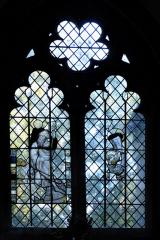
South west chancel window - Stanford-on-Avon, Northamptonshire

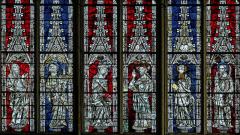
Medieval panels dated between 1330-1350 of three saints.
Medieval panels dated between 1330-1350 of three saints.
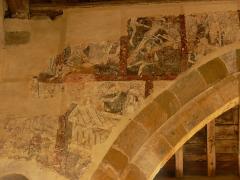
/info/node/2888At St Mary's Church, Lutterworth a large wall painting above the chancel arch represents the Last Judgement, traditionally known as the Doom. Christ sits enthroned on a rainbow at the centre of the composition while angels attend him, one sounding a trumpet that calls the dead to rise. Below, coffins open and figures emerge from the earth.
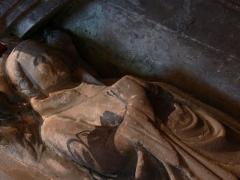
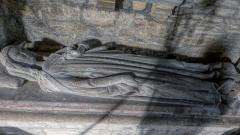
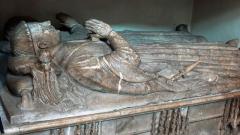
Mid C14 recumbent effigy of a priest in tomb recess.

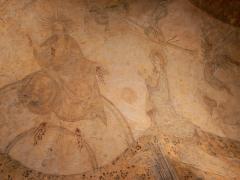
Part of a lost sequence known as the 'History of the Resurrection' this image of doubting Thomas ⓘ is probably mid 14th century. It was discovered in 1846, in the north transept of Saint Albans Cathedral beneath whitewash.
This tomb of Hugh and Elizabeth, in the chancel of Tewkesbury Abbey, is of alabaster and the effigies are portraits of them both. The canopy once contained 26 statutes and was considered one of the finest in England.
The east window at Gloucester Cathedral was created as part of the rebuilding of the abbey church of St Peter ⓘ. Built in the Perpendicular style it was the largest window in Europe. The decorative scheme portrays the Coronation of the Virgin and the glass mostly dates from the 1350s.
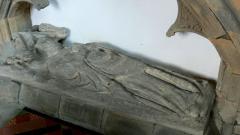
C14 effigy of priest in tomb recess.
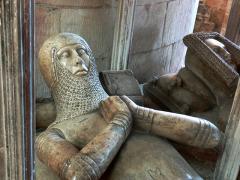
This is one of fewer than 100 surviving wooden knight figures in England, and transcends mere memorial: it immortalizes Sir John's legacy as a minor but dutiful baron, who was possibly involved in Edward III's French campaigns
 The parish church of the Blessed Virgin Mary ⓘ and Saint Leodegarius at Ashby St Ledgers in Northamptonshire has a C14 - C15 Passion sequence painted above the chancel arch and on the side walls. The sequence was uncovered during restoration work in 1927 and is the most extensive cycle in the UK. The paintings are of a similar date to those at Burton Dassett about 20 miles away.
Scholastica de Gayton, who died in 1354, was a member of the medieval de Gayton family, long associated with the village of Gayton in Northamptonshire. She was the daughter of Sir Philip de Gayton, who died in 1316 and whose own effigy also survives in the church of St Mary the Virgin at Gayton.
Polychome tomb with effigy of baron Peter de Grandison (d1358) and the Coronation of the Virgin above the effigy.
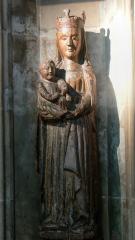
This wooden sculpture of the Virgin and Child, dating to the fourteenth century (most probably the mid to late 1300s, though sometimes described as early fifteenth century), is of Continental—likely French—origin.
Tomb of Thomas de Beauchamp (d1369) and his wife Katherine Mortimer.
Sir Richard Pembridge (d1375) was one of the earliest Knights of the Garter, being elected following the death of Thomas Ufford in 1368. He was present at all of Edward III's major victories during the Hundred Years War: Sluys (1340), Creçy (1346), the Siege of Calais (1347), and Poiters (1356) where he fought alongside the Black Prince.
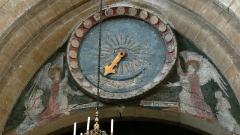
The painted clock a reminder of the passing of time ones mortality and the Last Judgment.
This early fifteenth century wall painting of Christ at the Last Judgement sitting on a rainbow between praying figures of the Virgin Mary ⓘ and St John the Evangelist ⓘ, can be found in the Collegiate Church ⓘ of St Aignan.
White marble effigy of Cardinal Jean de la Grange (d1402).
Large brass monument to William Bagot ⓘ (d1407) and his wife Margaret.
This is an early 15th century alabaster tomb of a knight and his wife, in the church of St Mary Lutterworth.
This two-light stained glass window, dating to around 1410, combines two devotional subjects of late medieval popularity: Saint Christopher in the left-hand light and Saint Anne with the Virgin Mary ⓘ in the right-hand light. The pairing reflects contemporary concerns with protection, instruction, and the visible presence of holiness in everyday life.