
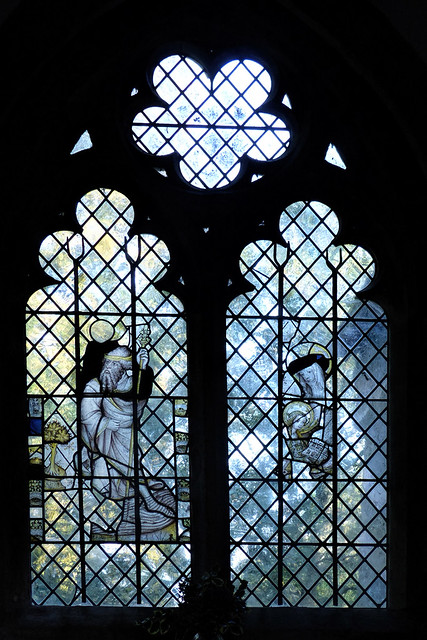
This two-light stained glass window, dating to around 1410, combines two devotional subjects of late medieval popularity: Saint Christopher in the left-hand light and Saint Anne with the Virgin Mary ⓘ in the right-hand light. The pairing reflects contemporary concerns with protection, instruction, and the visible presence of holiness in everyday life.
In the left-hand light, St Christopher is shown almost full-length, advancing with a staff in his hand. The figure is drawn in firm outline against a field of patterned quarries. To his left appears a small silver-stained flowering tree, rendered at a reduced scale and not integrated into the main figure space. This element was almost certainly part of a more extensive background in the original glazing scheme, now fragmentary.
The head of the Christ Child is missing, but the saint’s posture and attributes clearly identify him as the bearer of Christ and protector of travellers. The restrained use of colour and reliance on line and silver stain are characteristic of early fifteenth-century English glass, intended to preserve luminosity rather than pictorial depth.
The right-hand panel depicts St Anne teaching the Virgin to read, a subject that emphasises education, piety, and lineage. Anne guides the young Virgin’s attention to an open book, presenting learning as a sacred act and reinforcing Anne’s role as the first teacher in the Christian narrative.
Both panels are executed with restrained modelling and limited colour, relying on line drawing, silver stain, and textured white glass. This approach is characteristic of early fifteenth-century English glazing, designed to admit light while maintaining legibility of the figures. Border fragments and reused quarries suggest later rearrangement or conservation, but the original pairing of subjects remains intelligible.
Together, the two lights form a coherent devotional ensemble: Christopher offers protection to the viewer, while Anne represents moral and spiritual instruction. The window thus embodies key aspects of late medieval lay devotion within a compact architectural setting.
