Index of Gothic all

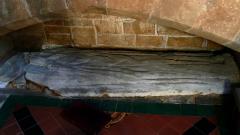
This polychromatic stone Holy Sepulchre in the church of Notre-Dame Neufchâtel-en-Bray dates from the mid C15.
This mid-fifteenth-century effigy depicts a priest shown vested for the celebration of Mass, carved in low relief and set beneath an architectural recess.

This mid 15th century window in the church of Saint-Taurin, Evreux, contains six scenes telling part of the legend of his life. This first panel tells the part of the legend where he resurrected a girl that had been burnt to death by a devil, on being brought back to life she was apparently unmarked.

This four-light window depicts the Four Great Fathers of the Western Church—St Ambrose, St Jerome, St Augustine, and Pope Gregory the Great—framed beneath an elaborate Gothic canopy. In the tracery lights above unfolds a Last Judgement scene, in which Christ appears in glory surrounded by angels and the resurrected dead, reinforcing the doctrinal authority of the Fathers through the lens of divine revelation.

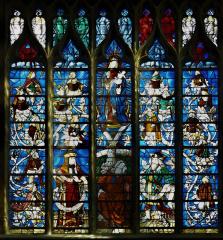
This window in Bourges Cathedral dates from 1460s and depict the four evangelists. In the tracery panels is the adoration of the Virgin.
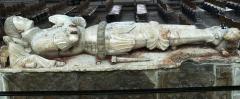
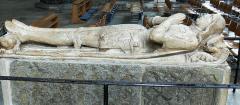
This monument of an alabaster knight wearing Milanese armour is dedicated to Robert Lord Hungerford (d1464).

This window was donated to the Cathedral by King Louis XI of France in 1467-1469. It's eight panels depicts events from the Resurrection to the Last Judgement of Christ.

This stained glass window (1467-1469) in the south wall of the Lady Chapel at Evreux Cathedral, depicts the Death of the Virgin Mary in the upper registers.
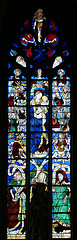
This stained glass window in the Lady Chapel of Evreux Cathedral was a given to the cathedral by King Louis XI of France between 1467 and 1469.

This four light window (1467-1469) in the north wall of the Lady Chapel at Evreux Cathedral, depicting scenes from Life of Christ, was a gift to the cathedral by King Louis XI of France.
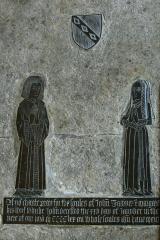
Brass monument to John Tawyer (d1470) and his wife.
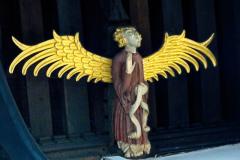
The timber roofs of the nave, chancel, and south-east chapel at All Saints date from the major late fifteenth-century rebuilding of the church, undertaken from c. 1470 onwards under the patronage of the wealthy wool merchants John and William Browne. This campaign transformed the clerestory, aisles, tower, and spire, and included the construction of richly carved angel roofs.
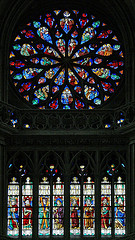
This rose window in the south transept of Evreux Cathedral was given to the Cathedral by Louis XI of France between 1470 and 1480. It is 6.5 metres in diameter and represents the Coronation of the Virgin in Heaven. Below the rose window the lancet windows in the Gallery contain representations of eight of the Apostles.
Bishop Ferry de Beauvoir (d1473). Amiens Cathedral France.
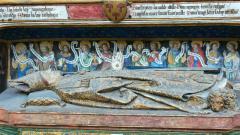
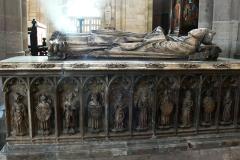
This carved alabaster monument of Bishop John Stanbury contains his effigy and has saints and angels as mourners carrying shields around all sides. Unfortunately the heads of the angels were chipped off during the reformation.
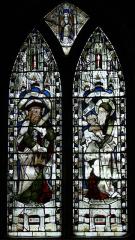
This window contains two significant pre-Reformation figural panels depicting St Peter (left) and St Simeon with the Christ Child (right). Both figures survive from a larger late medieval glazing scheme and were reassembled during the 19th-century restoration of the cathedral, when much of the surrounding decorative work was replaced.

Late Gothic staircase by Guillaume Pontis in 1480, under the direction of cardinal and archbishop William Estouteville. Rouen Cathedral.
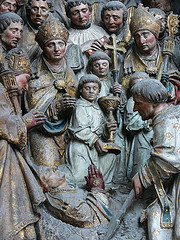
Polychrome reliefs retelling the legend of St Firmin a disciple of St Saturninus of Toulouse, founded the first church in Amiens in the third century.
Lord John Cheney (d1499) was a Lancastrian supporter who in 1483 had supported the Duke of Buckingham's rebellion against Richard III. When Buckingham's rebellion failed he joined Henry Tudor in Brittany and returned with him from France in 1485.
These pages document medieval stained glass in the churches of Rouen.