
Index of Gothic all
This tomb of William I Duke of Normandy (d942) in Rouen Cathedral dates from the 14th century. The earlier burial had been in the ancient sanctuary near the end of what is now the nave.

Robert Curthose (d1134) effigy, of painted Irish bog oak, was made about 100 years after his death.
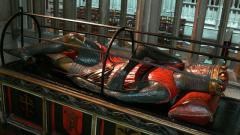
The Gothic period is characterized by the early simplicity of naturalistic figures to the late excessively enriched elegance and elaborate clothing of the figures in the later period, the subject matter of Gothic sculpture featured the mysticism of the mid to late medieval age with an emphasis on suffering and emotion.
"Presentation in the Temple" panel originally from Saint-Denis near Paris (c1145).

Chartres Cathedral has some of the most beautiful medieval stained glass windows to have survive the upheavals of the last 800 years. The earliest date from the mid 12th century, but most are from the 13th century.

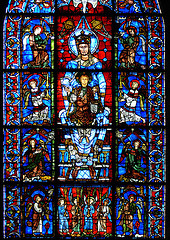
Set into a 13th century window, in the south ambulatory of the choir (bay 44) of Chartres Cathedral, this is one of the most celebrated medieval artworks in the Cathédrale Notre-Dame de Chartres.It dates primarily to c. 1180 CE, with later additions around 1225 CE, making it a rare survivor from the pre-1194 fire that destroyed the earlier Romanesque cathedral.
Designated a World heritage Site by UNESCO in 1979 the Cathedral of Notre-Dame de Chartres was built from between 1145 and 1250. It's high nave is spanned by ogival pointed arches to form the vault, and the walls are supported by double flying buttresses. Chartres is the first building to have used buttresses as a structural element.
Chartres Cathedral is also unique in having retained almost all of its original 12th and 13th century stained glass.
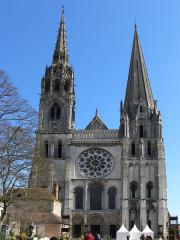

The south porch of Chartres Cathedral contains a series of sculptures, that were made between 1194 and 1230, on the subject of the martyrdom of saints.

In addition to the martyrs, the south porch contains a sequence of images of those that had proclaimed Christian beliefs during periods of suppression (confessors).
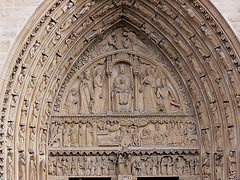 The portal of St Anne on the right of the western façade was built in 1200 and is the earliest of the three portals to be built. The tympanum is actually dated to about 1150 and was once part of the earlier cathedral of St. Stephen whose western façade was once 40 metres to the west of the present Cathedral.
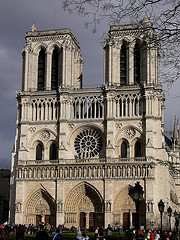
The western façade of the cathedral of Notre-Dame in Paris, with its twin towers, was built between 1200 and 1240. With its three portals containing scenes from the life of the Virgin Mary, the Last Judgment, and scenes from the life of St. Anne, it is considered one of the finest examples of early Gothic architecture.
In the 13th century (c. 1200–1300), church monuments were effigial tombs, cross slabs, and early brasses, emerging as Gothic art replaced Romanesque. They focused on piety, feudal status, and intercession, with stiff, symbolic figures.
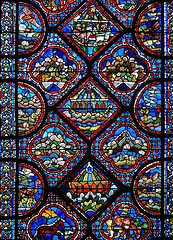
This early 13th century window depicts the story of Noah, was donated to the Cathedral of Chartres by the town's carpenters, wheelwrights, and coopers.
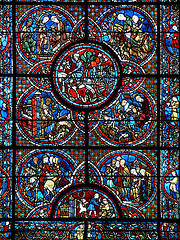
Saint Lubin, or Leobinus, was a 6th century bishop of Chartres. This window from the early 13th century depicts events in his life, and was donated to the cathedral by the Winesellers and innkeepers of the town of Chartres.
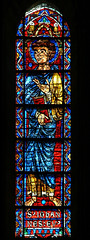 Window 204 consists of two tall lancets forming part of the celebrated early thirteenth-century clerestory glazing of Bourges Cathedral. The saints represented, Andrew on the left and John the Evangelist on the right, are shown as full-height standing figures beneath architectural canopies, framed by the characteristic geometric borders of the Bourges workshop.
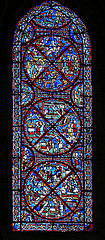
This stained glass window is dated between 1210 and 1215. Illustrating the discovery of the relics of St Stephen from a dream by Lucian. This window is situated in the ambulatory of Bourges Cathedral.
The Cathedral of St Stephen, Bourges contains a large number of medieval and renaissance stained glass. The glass panels date from 1210 - 1620 and represents Saints, Apostles, Prophets, and Bible stories.

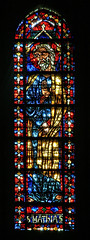
Window w.212, located high in the south choir clerestory of Bourges Cathedral, dates from c.1210–1215 and belongs to the earliest glazing phase of the High Gothic choir. The window presents two Evangelists, Mark and Luke, and one Apostle, Matthias.
This trio forms part of a wider apostolic–evangelist cycle distributed around the clerestory, each figure shown as a monumental standing saint set within a richly patterned Gothic frame.
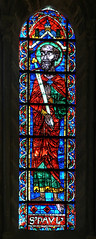 Window 202 contains a paired representation of the two foundational apostles, Peter and Paul. The window forms part of the southern run of apostolic lancets in the choir clerestory, executed by the same workshop responsible for the coherent sequence between w.202 and w.212.
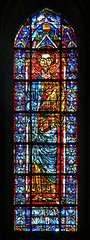
Window w.210 forms part of the southern clerestory apostolic cycle of Bourges Cathedral. Created in the first decades of the 13th century, this scheme is contemporary with the cathedral’s great choir and represents one of the finest ensembles of High Gothic stained glass in France.