
Index of Gothic all
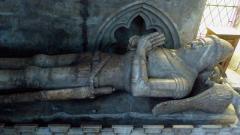
Tomb of William de Roos (d1414), 6th Baron Ros, 6th Baron Roos, Bottesford Leicestershire.
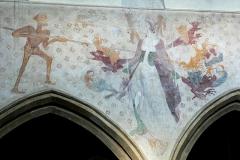
C15 (c1420-1450) painting on the subject of the "Seven Deadly Sins".
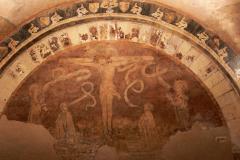
A common subject painted in medieval churches where scenes of the "Last Judgment" or "Doom". Often they would be painted above the chancel arch. A central figure of risen Christ with the instruments of the passion would be painted, or a crucifixion with the Virgin Mary and St John the Evangelist.

Fom about 1420, the figures on the right are thought to be Louis II of Chalon, count of Saint Aignan, his mother, and his second wife Jeanne de Perellos.

The two kneeling benefactors are thought to be Louis II of Chalon and Jeanne de Perellos.
This brass monument to William Wylde (d1422) and wife can be found in the church of St Mary, Dodford, Northamptonshire.
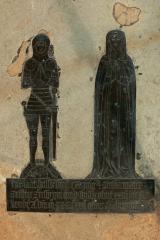
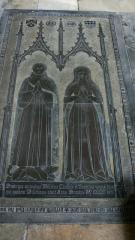
Brass monument to William Chichele (d1425) and wife. 4ft 3in figures under ogee gables.

The archangel St. Michael, is the principal angel and field commander of the Army of God. His name is the war-cry of the good angels in the battle fought in heaven against Satan and his followers. He is often depicted triumphant over the enemy.
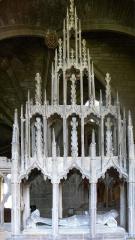
This two storied tomb for Richard de Beauchamp, 1st Earl of Worcester (d1421) was built in 1430 by his wife Lady Isabel le Despenser, the great grand-daughter of Edward III. It was probably meant to contain priant figures of both Richard, Isabel, and her second husband Richard de Beauchamp, 13th Earl of Warwick, who was her first husband's cousin.

The Marmousets Portal Tympanum is a late Gothic sculpture adorning the Porche des Marmousets (Portal of the Marmousets) is the main pedestrian entrance to the Abbey Church of Saint-Ouen in Rouen, Normandy, France. This Flamboyant Gothic portal, primarily honors the Virgin Mary, dates to around 1430 and was crafted by the master sculptor Alexandre de Berneval, and is located at the south transept.
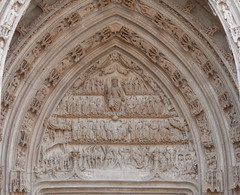
The tympanum above the central porch, of Saint-Maclou in Rouen depicts Christ in Majesty at the Last Judgement in four registers.
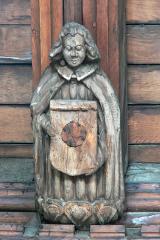
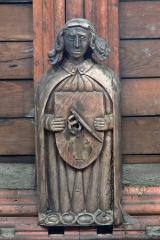
These carved oak Apostles at Dunstable Priory form part of the structural and iconographic programme of the timber roof, functioning as corbels supporting arched braces or hammer-beams. Oak, the standard and most durable timber for English ecclesiastical roofs, was universally favoured for such work, allowing both structural strength and detailed carving.
 ,
, 
This fresco by Fra Angelico 1438-1443) depicting the Coronation of the Virgin is in cell 9 of the San Marco monastery in Florence.

This images of Christ Carrying the Cross is in cell 28 of the San Marco convent.

In the Nativity scene from Cell 5, Fra Angelico presents a serene and deeply devotional vision of the birth of Christ. The composition centers on the Holy Family, Mary, Joseph, and the infant Jesus, surrounded by an atmosphere of quiet reverence.

This fresco (1438-1443) by Fra Angelico 1438-1443) depicting the Presentation in the Temple is in cell 10 of the San Marco monastery in Florence.

This Annunciation (1438-1443) frescoe, by Fra Angelico, is in cell 3 of the novice accommodation at San Marco Florence.

In cell 7 of San Marco monastery a fresco, by Fra Angelico assisted by Benozzo Gozzoli, depicts a blindfolded Christ who is enthroned holding a cane and a globe.

This fresco by Fra Angelico depicts the Transfiguration of Christ, one of the most radiant and spiritually charged scenes in the Gospel narrative. At the center, Christ stands upon a rocky elevation, enveloped in a great mandorla of divine light, his white garments gleaming with celestial brilliance.

This fresco of the "Scourging of Christ" is by Fra Angelico in cell 4 of the San Marco monastery.
