
Index of Gothic all
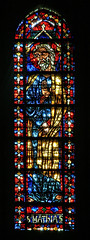
Window w.212, located high in the south choir clerestory of Bourges Cathedral, dates from c.1210–1215 and belongs to the earliest glazing phase of the High Gothic choir. The window presents two Evangelists, Mark and Luke, and one Apostle, Matthias.
This trio forms part of a wider apostolic–evangelist cycle distributed around the clerestory, each figure shown as a monumental standing saint set within a richly patterned Gothic frame.
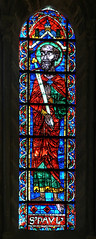 Window 202 contains a paired representation of the two foundational apostles, Peter and Paul. The window forms part of the southern run of apostolic lancets in the choir clerestory, executed by the same workshop responsible for the coherent sequence between w.202 and w.212.
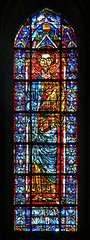
Window w.210 forms part of the southern clerestory apostolic cycle of Bourges Cathedral. Created in the first decades of the 13th century, this scheme is contemporary with the cathedral’s great choir and represents one of the finest ensembles of High Gothic stained glass in France.
Tomb of King John the youngest son of Henry II and Eleanor of Aquitaine. Made from Purbeck marble the sarcophagus dates from about 1230 and is the earliest effigy in the country to an English king. Originally the effigy would have lain on the floor, but as more elaborate tombs were installed in later years, John's effigy was raised up to rest on a tomb chest that was made in about 1540.

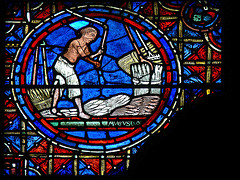
The left hand side of the Zodiac window at Chartres Cathedral contains the twelve months of the year. The panels here depicting July to December, were donated by count Thibault VI on behalf of Thomas of Perche.

Donated by Thibault VI count of Chartres, in 1217, on behalf of Thomas count of Perche, this window illustrates the signs of the zodiac on the right hand side of the window, and the labouirs of the months on the left hand side. The four central quatrefoils are split between the months and the zodiac.

The left hand side of the Zodiac window at Chartres Cathedral contains the twelve months of the year. The panels here depicting January to June, were donated by count Thibault VI on behalf of Thomas of Perche.
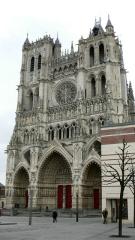
The western facade of the cathedral of Notre-Dame in Amiens contains 3 doorways. A central portal that opens into the nave, and two portals beneath the north and south towers that open into the cathedral's aisles. Above each portal is a tympanum the central one depicting the last Judgement, the northern one the transfer of the relics of St Firmin, and the south portal depicts the Virgin Mary.

The portal of St Firmin opens into the north aisle of Amiens Cathedral. The tympanum shows the discovery of his remains outside the city, and their transport to the cathedral.

Designated a UNESCO World Heritage Site in 1981 for the coherence of its plan, and the beauty of its three-tier interior elevation Notre-Dame d'Amiens, is the tallest completed Gothic church and largest cathedral in France. The Romanesque cathedral had been destroyed by fire in 1218, and Bishop Evrard de Fouilly employed Robert de Luzarches as the architect to build the new cathedral in the Gothic style to house the head of John the Baptist which had been bought back as a relic by Wallon de Sarton returning from Constantinople in 1206 after the 4th crusade.
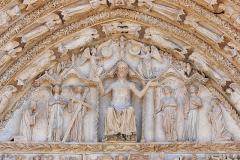
Gothic tympanum of the Last Judgement dating from about 1230 at Bourges Cathedral, France.
Tomb of William Longespee (d1226) Earl of Salisbury. William Longespee was the illegitimate son of Henry II and half brother to King Richard I and King John of England.
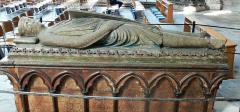
This effigy on a low tomb chest is thought to be Alexander of Holderness (d1226) abbot of Peterborough.

The central doorway was the last of the three portals, of Notre-Dame Cathedral Paris, to be decorated. Work started in about 1230 and consists of Christ in Majesty (showing the marks of the Crucifixion) with the Virgin Mary and St John on either side of him.


Sculpture of Old Testament stories in the spandrel on the Western facade of Bourges Cathedral.
Two 13th century effigies of Benedictine monks. Peterborough Cathedral.
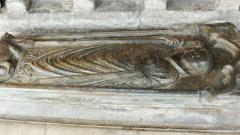

The biblical story of Cain and Abel in the spandrels of Bourges Cathedral.

Made between 1240-1255 by a Paris goldsmith, to hold the relics of St Taurin, this shrine was commissioned by the abbot Gislebert de Saint-Martin. The reliquary weighs 82kg and is made of bronze silver and gold leaf over a wooden chest.
The tympanum of St Stephen at Bourges cathedral was constructed by 1240, and is above one of the five portals at the west end of the cathedral. The tympanum is made up of three sections. The lowest section depicts Stephen being made one of the seven deacons of the early church. Above that is his martyrdom, and on top of all is an image of Christ as Salvator Mundi.
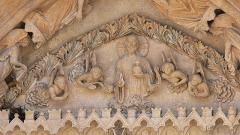

Decorated in about 1240 the spandrels below the portal of St Stephen at Bourges Cathedral contain sculpures depicting the story of Noah.