
Index of Gothic all
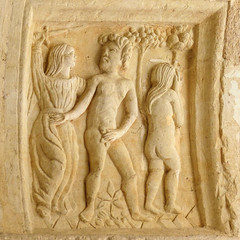
This group of eleven relief panels form part of the carved vault decoration of a sacristy bay at the Royal Abbey of Fontevraud. Executed in a soft, chalky limestone typical of the Loire region, the panels combine biblical narrative scenes with hagiographic episodes from the Life of St Nicholas and include one figure of architectural patronage.
This window in the North transept of Great Malvern Priory was a gift from Henry VII in 1501. Containing scenes from the life of the Virgin Mary and the life of Christ., it is known as the Magnificat window because it contains the Song of Mary from Luke 1:46-55.
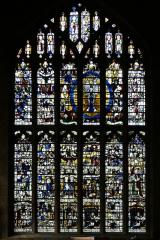
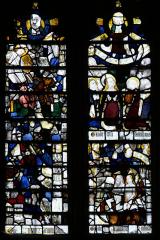
These panels from the 'Magnificat' window (1501) at Malvern Priory depict the Archangel Michael on the left. On the top right is Jesus ascent into Heaven, whilst the bottom right panel shows the damned descent into hell.
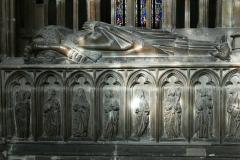
This chantry chapel to Arthur Tudor, covered in tracery and sculptures, was built in 1504. The chest tomb of the 15 year old Prince fills the chapel.

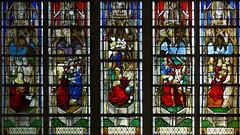 The south aisle of the nave at Saint-Ouen preserves one of the most varied yet coherent hagiographic ensembles in the church’s glazing programme. Although the windows today comprise mixtures of sixteenth-century fragments, nineteenth-century architectural refitting, and extensive twentieth-century restoration, they collectively articulate a single, sustained theme: the commemoration of exemplary saints whose lives, virtues, and martyrdoms offered models for Christian devotion.
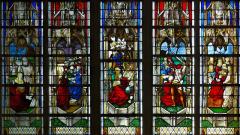
This window (c1508) depicts key moments from the life and martyrdom of St Catherine of Alexandria, a learned noblewoman whose legend was widely celebrated in late-medieval Europe. The glazing, produced by a Rouen workshop in the early sixteenth century, follows the characteristic format of the Saint-Ouen cycles: tightly framed narrative scenes beneath elaborate Gothic canopies, enriched with vivid colour and detailed architectural settings.

This image shows the Virgin and Child of Chartres Cathedral, commonly known as the Black Madonna of Chartres (Notre-Dame du Pilier). It is one of the most venerated Marian sculptures in France and a central focus of devotion within the cathedral. It was commissioned in 1508 as a black wooden copy of the 13th century silver Madonna that stood on the main altar at Chartres Cathedral.
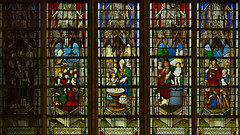
This window forms part of the late-medieval glazing cycle devoted to St Austremoine (St Austremonius), traditionally regarded as one of the missionary bishops sent from Rome to evangelise Gaul. The panels adopt the rich narrative style characteristic of Rouen workshops in the early sixteenth century, combining brightly modelled figures, deep architectural canopies, and landscape backdrops that open the narratives into broad, coherent sequences.
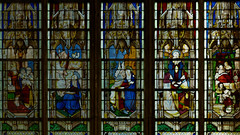
This window narrates episodes from the apocryphal infancy cycle concerning St Anne and St Joachim, parents of the Virgin Mary. Executed in the early sixteenth century by a Rouen workshop, the glass combines dense architectural canopies with clear, compartmentalised scenes, allowing the viewer to follow the story across multiple lights.
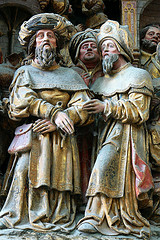
Polychriome reliefs telling the story of St James the Greater, and the conversion of Philetus and Hermogenes. Amiens Cathedral 1511.
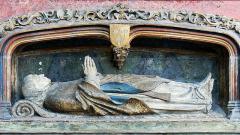
This tomb in the South choir contains the effigy of Bishop Richard Mayew (d1516) under an elaborate canopy, and with weepers around the base. The weepers are thought to represent saints and were damaged during the reformation.
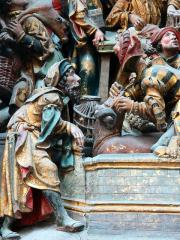
This richly animated cycle of polychrome reliefs depicts the episode of Christ Cleansing the Temple (Matthew 21:12–13; Mark 11:15–17; Luke 19:45–46; John 2:13–16). Carved in deep relief and originally conceived as a continuous narrative sequence, the scenes unfold across the west wall of the north transept, drawing the viewer into the crowded precincts of the Temple in Jerusalem.
Monument of Adrien Hénencourt (d1530) at Amiens Cathedral. This monument is below the choir screen (1490-1530) depicting the life of St Firmin that canon Hénencourt was responsible for commissioning.
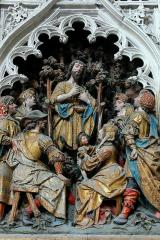
Polychrome reliefs on the north of the choir screen tell the story of the life of John the Baptist.
This window (c1550) presents a sequence from the Life and Martyrdom of St Agnes, the young Roman virgin celebrated for her steadfast refusal to accept a pagan suitor and her unwavering confession of faith. Produced by a Rouen workshop in the early sixteenth century, the window follows the typical Saint-Ouen format: narrative scenes set beneath tall Gothic canopies, framed by alternating architectural and landscape elements.
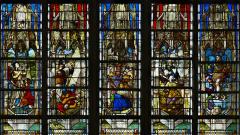
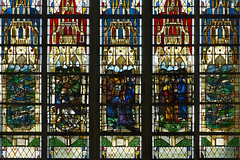
This window (c1550) is a composite assemblage combining fragments of sixteenth-century narrative glass with nineteenth-century architectural framing and extensive twentieth-century restoration. The programme appears to have depicted episodes from the life of an unidentified saint. According to Jean Lafond, one of the surviving scenes may represent the translation of relics, suggesting a cycle related either to Saint Ouen or Saint Leufroy. The identification, however, remains uncertain due to the fragmentary nature of the surviving iconography.
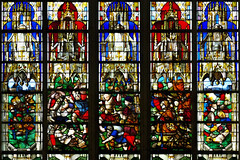
This window is a composite assembly combining fragments of sixteenth-century stained glass with nineteenth-century architectural structures and extensive twentieth-century restoration. The present arrangement consists of five tall lancets surmounted by a unified canopy system reconstructed in 1852, with bases and pedestals also installed at that time.
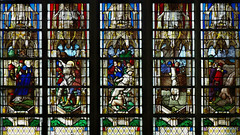
This window (c1550) illustrates episodes from the martyrdom of St Vincent of Saragossa, one of the most widely venerated deacons of the early Church. Created by a Rouen atelier in the early sixteenth century, the glass adopts the familiar layout of the Saint-Ouen narrative series: scenes arranged beneath richly architectural Gothic canopies, each panel presenting a distinct moment from the saint’s Passion.