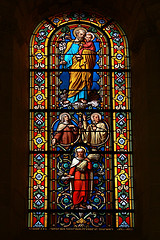
Dated 1887 this window of St Joseph, by Noel Lavergne, is in the church of Notre Dame la Blanche, Selles-sur-Cher.

Dated 1887 this window of St Joseph, by Noel Lavergne, is in the church of Notre Dame la Blanche, Selles-sur-Cher.
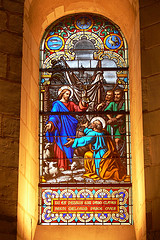
This window of St. Peter receiving the keys of heaven, in the church of Notre Dame la Blanche, Selles-sur-Cher, is by Claudius Lavergne. The window is dated 1889 which is two years after Claudius Lavergne's death.

Main panel of this Hardman window illustrates Jesus delivering the Sermon on the Mount.
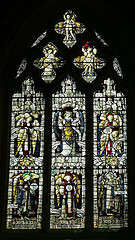 Hudson, Shrigley and Co were originally church decorators in Lancaster. In about 1871 they employed, Arthur Hunt from Hertfordshire, who had trained as a stained glass maker with Heaton, Butler and Bayne, as the company manager. Hunt had a good business sense and within 8 years had taken over control of the company, employing talented artist like Carl Almquist and Edward Jewitt. Carl Almquist became the chief designer for the firm in 1873 and from 1879 was working mainly from their newly acquired London Studio. The company also made art tiles and developed a style of figurative stained glass work that was inspired by the Renaissance rather than the Gothic

The south window of the chancel at All Saints, Middleton Cheney, contains two important stained-glass panels designed by Ford Madox Brown in 1870, created during his period of work for Morris, Marshall, Faulkner & Co. These windows are among the finest surviving examples of Brown’s contribution to Victorian ecclesiastical glass, characterised by his expressive figures, sculptural modelling, and dense narrative detail.
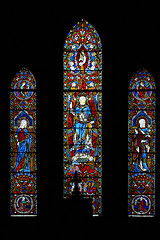
Stained glass by John Hardman in the church of St. Joseph Avon Dassett.
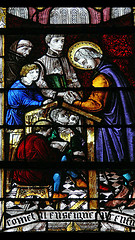
19th century stained glass of St. Leufroy (Leufredus) who was the founder of the Benedictine monastery at La-Croix Saint-Ouen, some 13km from Evreux. Leufroy grew up in Evreux and for a time was a teacher in the town.
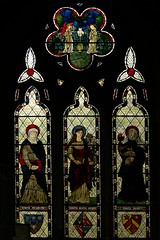
The north-aisle east window at Middleton Cheney contains two major stained-glass figures designed by Ford Madox Brown in 1880 for Morris, Marshall, Faulkner & Co. These works represent some of Brown’s finest ecclesiastical contributions and exemplify his distinctive approach to figural design, which differs markedly from that of colleagues such as Burne-Jones.
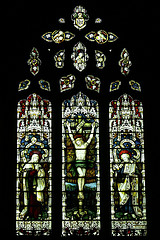
The story of stained glass in England is one of both loss and renewal. The medieval and Renaissance centuries had produced a luminous synthesis of theology, craft, and architecture, an art that translated divine light into visible doctrine. Yet, with the Reformation and subsequent waves of iconoclasm, much of this splendour was extinguished. For nearly three hundred years, the craft languished, its techniques fragmented and its spiritual vocabulary forgotten
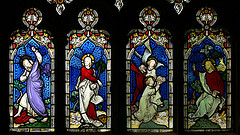 In the east arcade of the cloisters are two windows depicting the temptation of Christ. These windows were made in the 1860s by John Hardman and Co.
