
Selles-sur-Cher
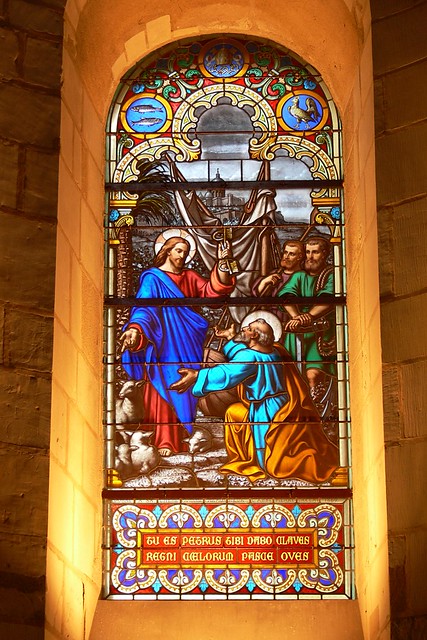
This stained-glass window depicting Saint Peter ⓘ receiving the keys of Heaven, installed in the church of Notre-Dame-la-Blanche at Selles-sur-Cher, is attributed to Claudius Lavergne and dated 1889. The date is significant, as it falls two years after Lavergne’s death, indicating that the window was executed posthumously, most likely by his workshop or immediate successors working from his designs.
The composition follows a traditional iconographic formula: Christ, centrally placed and hieratic, extends the keys to Saint Peter, who kneels or inclines forward in an attitude of reverent reception. Lavergne’s handling of the figures is characteristic of late 19th-century French ecclesiastical glazing, combining clear narrative legibility with restrained monumentality. The figures are firmly outlined, with expressive but controlled gestures, ensuring that the theological meaning of the scene remains immediately intelligible to the viewer.
Colour plays a central role in structuring the composition. Warm reds and golds associated with Christ are balanced against cooler blues and greens in the surrounding garments and architectural setting, creating a stable chromatic harmony. The glass painting is confident but not overworked: modelling is achieved through economical shading and well-judged line, rather than dense enamel, allowing light to remain an active presence within the window.
Stylistically, the window reflects Lavergne’s position within the academic tradition of French stained glass in the later 19th century, while also demonstrating the clarity and sobriety that made his work well suited to parish churches. The posthumous date suggests continuity of style and technique within his atelier, reinforcing the idea that Lavergne’s artistic language remained authoritative enough to be carried forward intact after his death.
