Arts and Crafts
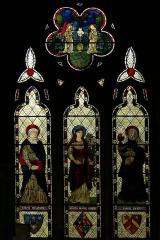
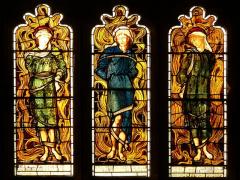
Founded as Morris, Marshall, Faulkner & Company in 1861 by the socialist artist and designer William Morris along with Ford Madox Brown, Dante Gabriel Rossetti, Peter Paul Marshall, Philip Webb, Charles James Faulkner, and Edward Burne-Jones. The company initially concentrated on ecclesiastical decoration including stained glass, and architectural carving from premises in London’s Red Lion Square, but moved to Queens Square, Bloomsbury in 1865.

The north-aisle east window at Middleton Cheney contains two major stained-glass figures designed by Ford Madox Brown in 1880 for Morris, Marshall, Faulkner & Co. These works represent some of Brown’s finest ecclesiastical contributions and exemplify his distinctive approach to figural design, which differs markedly from that of colleagues such as Burne-Jones.

The story of stained glass in England is one of both loss and renewal. The medieval and Renaissance centuries had produced a luminous synthesis of theology, craft, and architecture, an art that translated divine light into visible doctrine. Yet, with the Reformation and subsequent waves of iconoclasm, much of this splendour was extinguished. For nearly three hundred years, the craft languished, its techniques fragmented and its spiritual vocabulary forgotten

Caroline Charlotte Townshend (1878-1944) was the daughter of the Suffragette Emily Townshend. She created the Fabian window from a design by George Bernard Shaw in 1910. After the first world war she set up home with her partner Joan Howson.
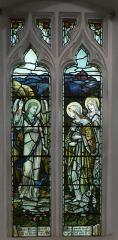
Christopher Whall (1849-1924), studied art at the Royal Academy Schools where he became influenced by the Pre-Raphaelites. After leaving the Royal Academy in 1879 he specialized in stained glass, working for John Powell & sons as a designer, but started his own company when he wanted to learn the whole craft of stained glass making.

William Morris (1834–1896) stands as one of the central figures in the revival of British stained glass during the second half of the nineteenth century. Through the firms Morris, Marshall, Faulkner & Co. and later Morris & Co., his designs — and those of his close collaborators, especially Edward Burne-Jones, Ford Madox Brown, and Dante Gabriel Rossetti — transformed the visual language of Victorian church decoration.