Medieval
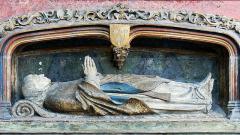
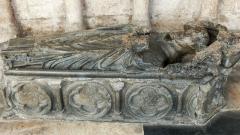
13th century church monuments
In the 13th century (c. 1200–1300), church monuments were effigial tombs, cross slabs, and early brasses, emerging as Gothic art replaced Romanesque. They focused on piety, feudal status, and intercession, with stiff, symbolic figures.
15th century wooden Apostles - Dunstable Priory
These carved oak Apostles at Dunstable Priory form part of the structural and iconographic programme of the timber roof, functioning as corbels supporting arched braces or hammer-beams. Oak, the standard and most durable timber for English ecclesiastical roofs, was universally favoured for such work, allowing both structural strength and detailed carving.
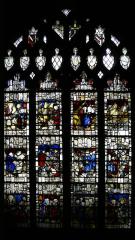
Abraham, Sarah, and Isaac
This window in the St Anne Chapel, Malvern Priory, has twelve scenes depicting the Story of Noah and the Flood, and birth of Isaac. It is dated to between 1440-1450 and was probably the gift of Isabel Despenser and Richard de Beauchamp, 13th earl of Warwick.
The bottom register of the window shows four scenes from the story of Abraham, Sarah, and the birth of Isaac.
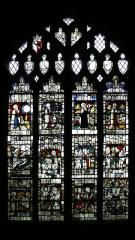
Adam and Eve and the Fall
This window in the St Anne Chapel, Malvern Priory, has twelve scenes depicting the Creation story and the Fall. It is dated to between 1440-1450 and was probably the gift of Isabel Despenser and Richard de Beauchamp, 13th earl of Warwick.
The middle register of the window illustrate the creation of Adam and Eve, the Forbidden Fruit, and the Fall.