William Bagot Brass - Baginton, Warwickshire.

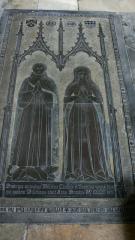
Large brass monument to William Bagot (d1407) and his wife Margaret.
Large brass monument to William Bagot (d1407) and his wife Margaret.
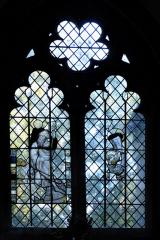
This two-light stained glass window, dating to around 1410, combines two devotional subjects of late medieval popularity: Saint Christopher in the left-hand light and Saint Anne with the Virgin Mary ⓘ in the right-hand light. The pairing reflects contemporary concerns with protection, instruction, and the visible presence of holiness in everyday life.
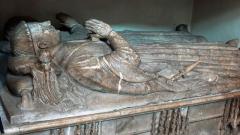
This is an early 15th century alabaster tomb of a knight and his wife, in the church of St Mary Lutterworth.
This 19in high brass monument is dedicated to John Cressy (d1414) and his wife Christine, can be found in the churchj of St Mary Dodford, Northamptonshire.
Tomb of William de Roos (d1414), 6th Baron Ros, 6th Baron Roos, Bottesford Leicestershire.

The Ospedale degli Innocenti in Florence stands at the intersection of art, architecture, and social conscience. Commissioned in 1419 by the Arte della Seta (Silk Guild) and designed by Filippo Brunelleschi ⓘ, it was both a revolutionary architectural achievement and a profoundly humane institution: the first purpose-built orphanage in Europe.
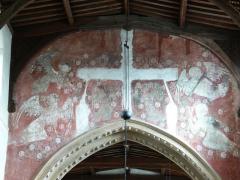
A common subject painted in medieval churches where scenes of the "Last Judgment" or "Doom". Often they would be painted above the chancel arch. A central figure of risen Christ with the instruments of the passion would be painted, or a crucifixion with the Virgin Mary ⓘ and St John the Evangelist ⓘ.
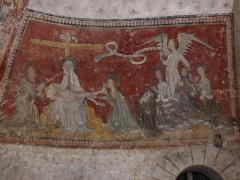
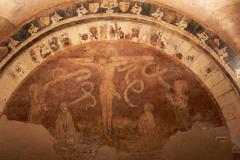
Fom about 1420, the figures on the right are thought to be Louis II of Chalon, count of Saint Aignan, his mother, and his second wife Jeanne de Perellos.
The two kneeling benefactors are thought to be Louis II of Chalon and Jeanne de Perellos.
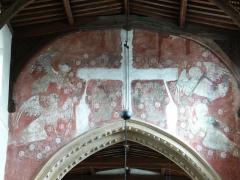
Medieval background (c1420) to Rood. Raunds, Northamptonshire.
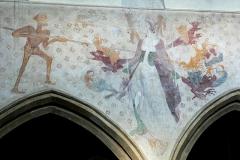
C15 (c1420-1450) painting on the subject of the "Seven Deadly Sins".
This brass monument to William Wylde (d1422) and wife can be found in the church of St Mary, Dodford, Northamptonshire.
Fresco painting by Masaccio ⓘ in the Brancacci Chapel in the church of Santa Maria del Carmine, Florence. This panel was painted at the same time as the panel depicting the "The Temptation of Adam and Eve" by Masolino on the opposite wall. Masolino and Masaccio, were both prominent 15th-century Italian painters, and worked together on the Brancacci Chapel frescoes, offering a clear basis for comparison.
Painted between 1425 and 1427 by Masaccio ⓘ for the Brancacci Chapel in Santa Maria del Carmine, this fresco depicts Saint Peter ⓘ healing the sick as his shadow falls upon them. The scene forms part of the chapel’s cycle illustrating the life of Saint Peter.
The work exemplifies Masaccio’s revolutionary approach to space, light, and human presence.
Brass monument to William Chichele (d1425) and wife. 4ft 3in figures under ogee gables.
The Prato pulpit was commissioned by the Operai del Duomo di Prato for the exterior corner of the cathedral, specifically to display the Sacra Cintola (Holy Belt of the Virgin Mary ⓘ), Prato’s most treasured relic.

The archangel St. Michael, is the principal angel and field commander of the Army of God. His name is the war-cry of the good angels in the battle fought in heaven against Satan and his followers. He is often depicted triumphant over the enemy.
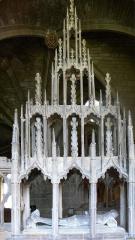
This two storied tomb for Richard de Beauchamp, 1st Earl of Worcester (d1421) was built in 1430 by his wife Lady Isabel le Despenser, the great grand-daughter of Edward III. It was probably meant to contain priant figures of both Richard, Isabel, and her second husband Richard de Beauchamp, 13th Earl of Warwick, who was her first husband's cousin.
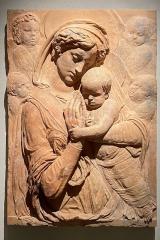
In fifteenth-century Florence, the image of the Virgin and Child underwent a quiet revolution. From the solemn, hieratic figures of late Gothic piety, the Madonna became an image of tender humanity, no longer distant and majestic, but immediate, emotional, and profoundly relatable. This transformation mirrors a broader shift in Renaissance devotion: the movement of sacred experience from church to home, from the grandeur of the altar to the intimacy of domestic life.