PeriodIndex
Great Malvern Priory
A substantial body of medieval stained glass survives at Great Malvern Priory, although its condition and completeness vary considerably from window to window. Several major fifteenth-century windows remain largely intact, most notably the Magnificat Window, the Founder’s Window, and the glazing of the Lady Chapel. Elsewhere, survival is more fragmentary: the great east window, though once a dominant feature of the church, now survives largely in dispersed panels and fragments rather than as a complete scheme.
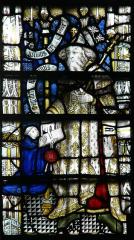
This fifteenth century stained glass panel depicts William the Conqueror ⓘ, in 1085, giving a charter to the monk Aldwin. It can be found in the north wall clerestory ⓘ window of the chancel in Great Malvern Priory.
Seven days of Creation
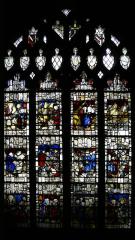
This window in the St Anne Chapel, Malvern Priory, has twelve scenes depicting the Creation story and the Fall. It is dated to between 1440-1450 and was probably the gift of Isabel Despenser and Richard de Beauchamp, 13th earl of Warwick.
The four panels in the top register of the window illustrate the seven days of creation.
Adam and Eve and the Fall
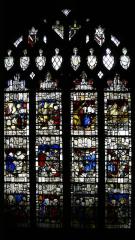
This window in the St Anne Chapel, Malvern Priory, has twelve scenes depicting the Creation story and the Fall. It is dated to between 1440-1450 and was probably the gift of Isabel Despenser and Richard de Beauchamp, 13th earl of Warwick.
The middle register of the window illustrate the creation of Adam and Eve, the Forbidden Fruit, and the Fall.
Noah and the Flood
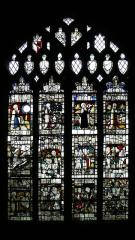
This window in the St Anne Chapel, Malvern Priory, has twelve scenes depicting the Story of Noah and the Flood, and birth of Isaac ⓘ. It is dated to between 1440-1450 and was probably the gift of Isabel Despenser and Richard de Beauchamp, 13th earl of Warwick.
The top register of the window shows four scenes from the story of Noah and the flood.
Abraham, Sarah, and Isaac
This window in the St Anne Chapel, Malvern Priory, has twelve scenes depicting the Story of Noah and the Flood, and birth of Isaac ⓘ. It is dated to between 1440-1450 and was probably the gift of Isabel Despenser and Richard de Beauchamp, 13th earl of Warwick.
The bottom register of the window shows four scenes from the story of Abraham ⓘ, Sarah, and the birth of Isaac.
The Evangelists and the Fathers - Bourges Cathedral
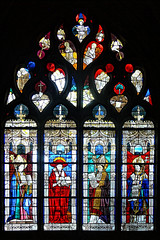
Forming part of the mid-15th-century glazing campaign at Bourges Cathedral, the Doctrinal Cycle unites two companion windows — one devoted to the Four Evangelists and the other to the Four Latin Fathers of the Church. Conceived as intellectual pendants, these windows express the harmony between Revelation and Interpretation, the written Word of God and its authoritative exposition by the great theologians of the Western Church.
Expulsion from Eden
This window in the St Anne Chapel, Malvern Priory, has twelve scenes depicting the Creation story and the Fall. It is dated to between 1440-1450 and was probably the gift of Isabel Despenser and Richard de Beauchamp, 13th earl of Warwick.
The four panels in the bottom register of the window illustrates the expulsion from Eden.
Noah gets Drunk
This window in the St Anne Chapel, Malvern Priory, has twelve scenes depicting the Story of Noah and the Flood, and birth of Isaac ⓘ. It is dated to between 1440-1450 and was probably the gift of Isabel Despenser and Richard de Beauchamp, 13th earl of Warwick.
The middle register of the window shows four scenes from the story of Noah following the flood.
St Anne's Chapel
St Anne Chapel in Great Malvern Priory is in the south choir aisle, there is no indication however that it was known to be dedicated to St Anne before the nineteenth century. This chapel has three windows with mid fifteenth century class depicting Old Testament stories.
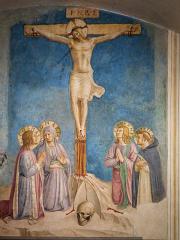
Crucifixion Fra Angelico - Chapter House, San Marco, Florence
This crucifixtion fresco (1441-1442) is by Fra Angelico ⓘ in the Chapter House of the San Marco monastery in Florence.
Adoration of the Magi (cell 39)
Cell 39 on the second floor of the San Marco convent was reserved for Cosimo de Medici. The fresco on the wall is the Adoration of the Magi by Benozzo Gozzoli ⓘ.
Crucifixion with Saints and Virgin (cell 38)
Crucifixion fresco (1441-2) by Fra Angelico ⓘ in cell 38 on the second floor of the San Marco convent.
Louis of Luxemboug Tomb - Ely Cathedral
Louis of Luxemboug (d1443). Brother of the governor of Paris who sold Joan of Arc to the English.
John Dycson Tomb - Yelvertoft Northamptonshire.
At Yelvertoft Northamptonshire is the tomb of John Dycson, who served as rector of Yelvertoft from 1439 to 1445, is a fine example of 15th-century English funerary art in the Perpendicular Gothic style. The monument consists of an alabaster effigy resting upon a low tomb chest, its sides richly decorated with panels of quatrefoils and other intricate tracery characteristic of the period.
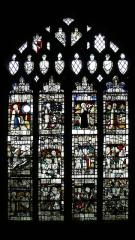
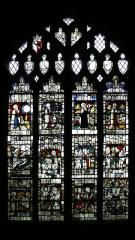
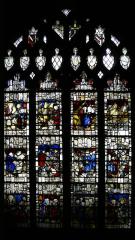
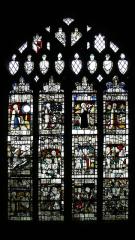
Founders' window
The so-called Founders’ Window at Great Malvern Priory is one of the most important narrative glazing schemes to survive in the church. Set high in the north clerestory ⓘ of the chancel, the window is composed of four lights arranged in two registers, presenting a visual history of the foundation of the priory that combines legend, royal authority, and aristocratic patronage.
John Cressy Tomb - Dodford Northamptonshire
Alabaster tomb of Sir John Cressy (d1445) Dodford, Northamptonshire. The sides of the tomb chest have angels holding shields, and the offices he held in France are listed around the top edge.
Richard de Beauchamp, 13th Earl of Warwick
This is the tomb of Richard de Beauchamp, 13th Earl of Warwick. who died at Rouen on the 30th April 1439. His will made an endowment to the collegiate church ⓘ of St Mary, Warwick, money to build the chantry chapel ⓘ at St Mary's, and gifts to Tewkesbury Abbey.
'Wakeham' Cenotaph - Tewkesbury Abbey
Attributed to John Wakeham (d1549), the last abbot of Tewkesbury, the 'Wakeham' Cenotaph, actually mid fifteenth century and pre-dates the abbot by about 100 years. The effigy is a gisant as a decomposing corpse and the canopy was modelled on the throne of the House of Lords.