PeriodIndex

Lady Harrington Floor Slab - Gayton Northamptonshire
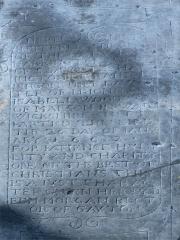
Lady Harrington Floor Slab - Gayton Northamptonshire

The floor slab to Lady Harrington in St Mary’s Church, Gayton, is a fine example of 17th-century commemorative stonework, combining formal design with a strikingly personal tone. Carved from smooth local limestone, its simple border and restrained scrollwork at either end frame an inscription notable for both its clarity and warmth.

Bishop John Gauden - Worcester Cathedral

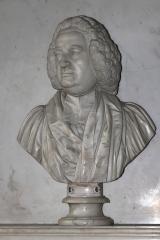
Bishop John Gauden - Worcester Cathedral

Bust of Bishop John Gaugen (d1662), Worcester Cathedral. John Gaugen was made Bishop of Worcester in May 1662 but died in September 1662 of "stone and strangury" - a complication of kidney stones.


Warwick - Last Judgment after Michelangelo

Warwick - Last Judgment after Michelangelo

This "Doom" painting in St Mary's Warwick, is copy (1678), by Richard Bird, of Michelangelo's Last Judgment in the Sistine Chapel. The left hand side of the work has been restored but the right hand side left unrestored at present.


Elizabeth Orme Monument - Aston-le-Walls, Northamptonshire

Elizabeth Orme Monument - Aston-le-Walls, Northamptonshire

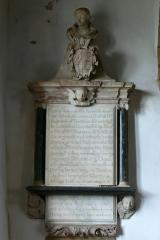
An inscribed wall monument of white marble with black Ionic half-columns, surmounted by a sculpted bust and heraldic cartouche, commemorating Elizabeth Orme, who died on 20 January 1692. The monument combines classical architectural framing with emotive figurative carving, including a cherub’s head beneath the cornice, and belongs firmly to the late 17th-century English commemorative tradition.

18th-century wall monuments

18th-century wall monuments

18th-century wall monuments (c. 1701–1800) dominate church commemoration. Marble tablets and architectural compositions combine inscription, classical ornament, and allegorical imagery to celebrate character, benevolence, and domestic virtue within a Protestant moral framework.

18th-century brasses

18th-century brasses

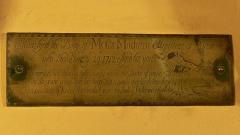
18th-century brasses (c. 1701–1800) are rare survivals of an earlier commemorative tradition. When used, they are typically modest and inscriptional, reflecting Enlightenment restraint and the declining role of figurative imagery in Protestant memorial culture.

18th-century tombs

18th-century tombs

18th-century tombs (c. 1701–1800) are comparatively uncommon and generally restrained in form. When present, they emphasize classical proportion, lineage, and moral virtue rather than effigial display, reflecting Enlightenment ideals of reason and decorum.

Judge John Powell - Gloucester Cathedral

Judge John Powell - Gloucester Cathedral

This marble monument to Judge John Powell (d1714) is by Thomas Green of Camberwell. John Powell presided over the trial of Jane Wenham, one of the last people convicted of witchcraft in England.


Galileo Galilei Tomb - Santa Croce Florence

Galileo Galilei Tomb - Santa Croce Florence

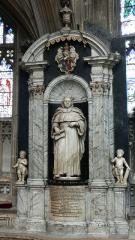
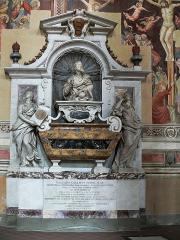
The tomb of Galileo Galilei (d1642) at Santa Croce in Florence was erected in 1737. It was designed by Giulio Foggini and contains a bust of Galileo Galilei (by Giovanni Battista Foggini ), and figures representing Astronomy (by Vincenzo Foggini ), and Geometry (by Girolamo Ticciati ).


Francesco Algarotti - Camposanto Monumentale, Pisa

Francesco Algarotti - Camposanto Monumentale, Pisa

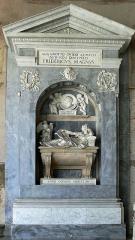
This tomb dedicated to Francesco Algarotti (d1764), in the Camposanto Monumentale, Pisa, was designed by Mauro Antonio Tesi . It was erect on the instructions of Frederick the Great of Prussia.


Thomas Langton Freke - King's Sutton, Northamptonshire

Thomas Langton Freke - King's Sutton, Northamptonshire

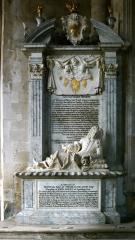
This dramatic plaster wall monument, dated 1769, commemorates Thomas Langton Freke and is mounted at Kings Sutton, though not in its original position. The work has been attributed to John Bacon, but its style is more convincingly aligned with the Baroque sculptural tradition associated with Louis-François Roubiliac.

Thomas Street - Worcester Cathedral

Thomas Street - Worcester Cathedral

This memorial to Sir Thomas Street (d1696) is the work of the sculptor Joseph Wilton a founding member of the Royal Academy, and was made around 1774.


Pages