
Thomas Langton Freke - King's Sutton, Northamptonshire
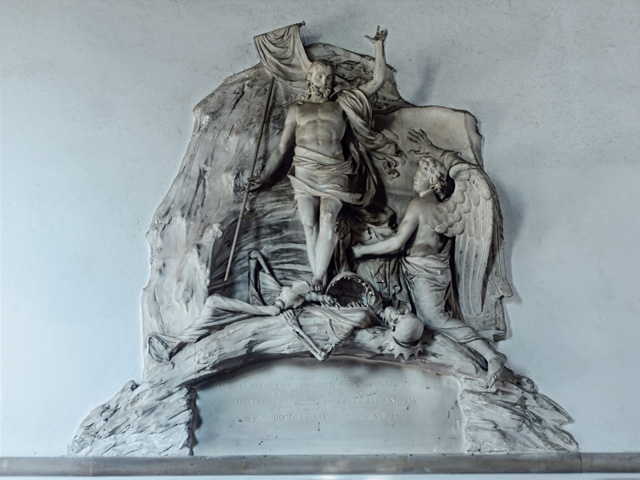
This dramatic plaster wall monument, dated 1769, commemorates Thomas Langton Freke, esquire, and is now displayed at Kings Sutton, though it is not in its original position. Long attributed to John Bacon, the monument is more convincingly understood as the work of an English sculptor operating in the Baroque tradition associated with Louis-François Roubiliac.
The composition is conceived as a rugged rocky landscape, from which Christ rises in triumph, his right arm raised in a gesture of victory and blessing. Lightly draped and holding the banner staff of the Resurrection, he stands above death itself, proclaiming the promise of salvation.
Beneath Christ’s feet lies a recumbent skeleton, rendered with striking anatomical realism. The gaping ribcage and hollowed chest confront the viewer with an uncompromising memento mori, dramatically subdued by the living Christ above. To the right, a kneeling angel turns upward in reverent awe, its softly modelled form contrasting with the stark brutality of the skeletal remains.
Beyond his commemoration in sculpture, Thomas Langton Freke, esquire of Bristol, is documented as having been involved in official commissions and inquisitions of lunacy, an eighteenth-century legal process concerned with determining mental incapacity and the administration of estates. Records relating to these proceedings survive in the official archives of the UK government, situating Freke within the civic and judicial framework of his time.
The monument’s fractured rockwork, animated drapery, and emotionally charged figures place it firmly within the survival of English Baroque sculpture in the mid-eighteenth century, executed in plaster rather than marble, and likely reflecting either a workshop production or a provincial adaptation of metropolitan sculptural fashion.
