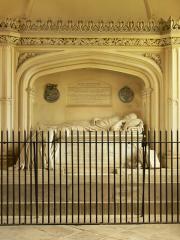
Sarah Morley monument - Gloucester Cathedral.
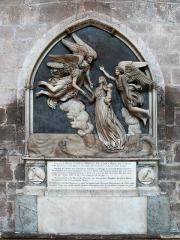
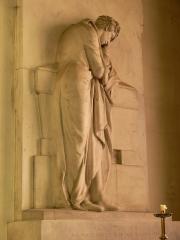
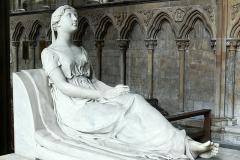
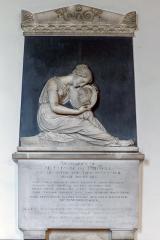
This monument by John Flaxman ⓘ is to Sarah Morley (d1784) who died a few days after giving birth whilst travelling back to England from India. Both Sarah and her child were buried at sea.
This monument by John Flaxman ⓘ is to Sarah Morley (d1784) who died a few days after giving birth whilst travelling back to England from India. Both Sarah and her child were buried at sea.
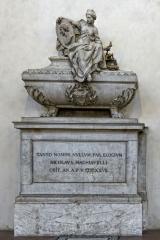
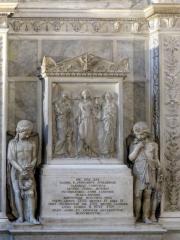
This tomb, dedicated to Niccolò Machiavelli (d1527), was created by Innocenzo Spinazzi ⓘ in 1787, and is in Santa Croce Florence.
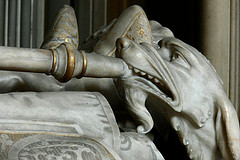
Church brasses, tomb chests, effigies, and sculpture from 1900 - 2000 AD.
19th-century tombs (c. 1801–1900) range from restrained memorials to highly elaborate architectural monuments. Influenced by Gothic Revival and Romantic historicism, they emphasize identity, family memory, and renewed Christian symbolism through sculpture, inscription, and material richness.
19th-century wall monuments (c. 1801–1900) are the most prolific and visually varied form of commemoration. Tablets, reliefs, and sculptural ensembles combine revival styles, moral sentiment, and biographical detail, reflecting Victorian attitudes to memory, faith, and social achievement.
Monument to Richard Solly (d1803) by John Bacon Jr ⓘ.
Count Vittorio Alfier (d1803) was an Italian poet and dramatist who wrote some 19 tragedies between 1775-1787.
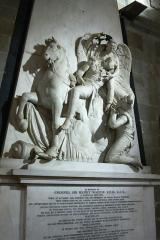
This monument placed by the officers and men of the royal Welch Fusiliers is by John Bacon Jr ⓘ. It depicts Col Sir Henry Walton Ellis falling from his horse, with Victory crowning him with a Laurel wreath.
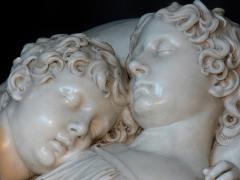
Sculpted from white marble by Sir Frances Chantrey, this memorial is to the two daughters of Ellen-Jane Robinson, Ellen-Jane and Marianne.
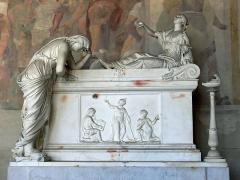
This elegant Neoclassical funeral monument, located in the portico of the Camposanto Monumentale within Pisa's Piazza dei Miracoli, commemorates Anastasia Petri-Schouvaloff (dates uncertain, likely 18th–19th century).
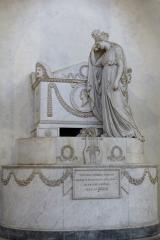
This tomb of Princess Louise of Stolberg-Gedern (d1824) is situated in San Croce Florence
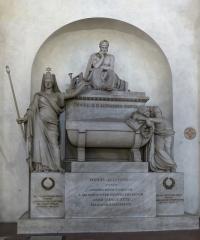
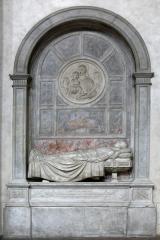
Tomb of Dante Alighieri (d1321) by Ricci Stefano (c1825).
The life size figure, by William Behnes ⓘ, is that of Charlotte's son. Charlotte Botfield died in 1825.
Monument to Charlotte Elizabeth Digby (d1820) by Francis Leggatt Chantrey. Charlotte Digby was the wife of William Digby, prebendary of Worcester Cathedral.
Thomas Otway Cave (d1830) by Kessels ⓘ. Relief of dying man, with woman seated on his couch, and winged genius with extinguished torch by his head.
This wall monument, dated 1831, commemorates Elizabeth Darnell and is located at Thrapston, Northamptonshire. It was commissioned by her daughter, Mary Montague, and is signed by the sculptor Edward Physick ⓘ (1810–1842), whose short career produced a small but refined body of funerary work.
Tomb of the Italian engraver Raffaello Sanzio Morghen (d1833) in Santa Croce Florence.
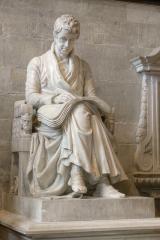
This sculpted monument commemorates Sir Richard Colt Hoare (d1818) and is located in Salisbury Cathedral. It was carved by the sculptor Richard Cockle Lucas ⓘ, one of the most distinctive British sculptors of the early nineteenth century.
Hoare is shown seated, absorbed in the act of reading and writing. A large open manuscript rests across his knees, presenting him not as a figure of rank or authority but as an active scholar. His contemporary dress is rendered with close attention to texture and fall, reinforcing the sense of immediacy and naturalism.
Monument to Bishop Joseph Allen (1845).
Monument by Richard Westmacott Jr ⓘ to Robert (d1844) and Sophia (d1849) Otway Cave.