Thomas and Agnes Andrewes Brass - Church Charwelton, Northamptonshire

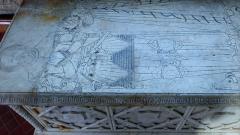
Thomas Andrewes shown in armour and bare headed, whilst his wife Agnes wears a huge head-dress and the long hanging sleeves fashionable at the time.
Thomas Andrewes shown in armour and bare headed, whilst his wife Agnes wears a huge head-dress and the long hanging sleeves fashionable at the time.
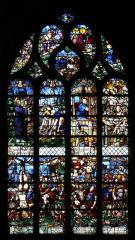
This window in Saint-Étienne ⓘ de Beauvais, is dated 1548 and i9s signed by Nicolas le Prince. It contains three scenes from the life of St Peter ⓘ, and the conversion of St Paul ⓘ on the Road to Damascus.
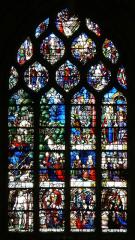
This window (c1550) presents a sequence from the Life and Martyrdom of St Agnes ⓘ, the young Roman virgin celebrated for her steadfast refusal to accept a pagan suitor and her unwavering confession of faith. Produced by a Rouen workshop in the early sixteenth century, the window follows the typical Saint-Ouen format: narrative scenes set beneath tall Gothic canopies, framed by alternating architectural and landscape elements.
The church at Saint Romain sur Cher was rebult in the C16 and restored in the C19. The north and south walls of the apse are painted with scenes of the Decapitation of John the Baptist ⓘ and the Baptism of Christ on the north wall, and on the south wall is the Resurrection. Both of these paintings were restored in 1859.
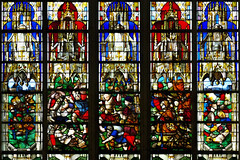
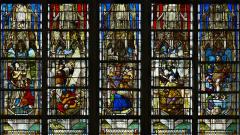
This window is a composite assembly combining fragments of sixteenth-century stained glass with nineteenth-century architectural structures and extensive twentieth-century restoration. The present arrangement consists of five tall lancets surmounted by a unified canopy system reconstructed in 1852, with bases and pedestals also installed at that time.
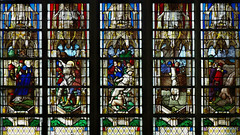
This window (c1550) illustrates episodes from the martyrdom of St Vincent ⓘ of Saragossa, one of the most widely venerated deacons of the early Church. Created by a Rouen atelier in the early sixteenth century, the glass adopts the familiar layout of the Saint-Ouen narrative series: scenes arranged beneath richly architectural Gothic canopies, each panel presenting a distinct moment from the saint’s Passion.
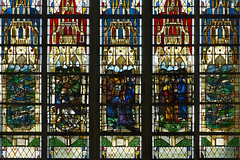
This window (c1550) is a composite assemblage combining fragments of sixteenth-century narrative glass with nineteenth-century architectural framing and extensive twentieth-century restoration. The programme appears to have depicted episodes from the life of an unidentified saint. According to Jean Lafond, one of the surviving scenes may represent the translation of relics, suggesting a cycle related either to Saint Ouen or Saint Leufroy. The identification, however, remains uncertain due to the fragmentary nature of the surviving iconography.
Full length figure brass of Sir Richard Catesby 1553, wearing tabard with Catesby Arms.
The stained-glass window illustrating the Legend of St Eustace ⓘ (baie n° 18) in Saint-Étienne ⓘ de Beauvais is a composite Renaissance work, produced in successive campaigns between 1553 and c. 1575. Its extended execution reflects a cumulative process of patronage, bringing together multiple donors, artists, and workshops within a single coherent narrative cycle.
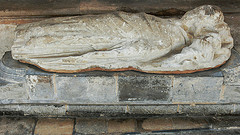
Effigy of John Chambers (d1556) last abbot and first bishop of Peterborough. Described in the 17th century as being exquisitely carved, with a mitre and robe, and feet resting on a lion, this effigy was mutilated during the English Civil War.
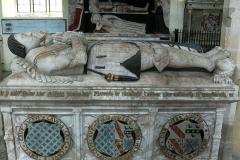
Francis Tanfield was a member of a gentry family long settled at Gayton, Northamptonshire. The Tanfields held land in the county from at least the 14th century, and like many such families, maintained their position through estate management and service in local administration. Francis died in 1558, and his monument in St Mary’s Church was probably commissioned by his widow soon afterwards.
Alabaster free standing tomb to Thomas Cave (c1558).
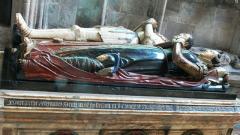
Tomb of Sir Thomas Andrews (d1564) and his two wives, Katherine and Mary.
This brass is dedicated to Richard Pynfold (d1566) and his wife.
This alabaster monument to Alexander Denton and his wife Anne (nee Willison), dates from about 1566. Anne his wife and the child by her side are the only ones that are buried here.
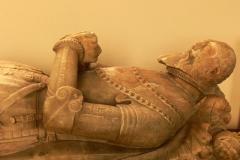
Alabaster tomb effigy of Sir Michael Poulteney (d1567).
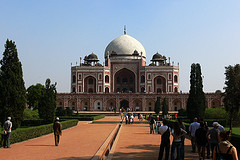 This tomb to Humayun was commissioned in about 1570, by either his wife Haji Begam or his son Akbar the Great, and built at a cost of 1.5 million rupees. It is thought to be the first garden tomb on the Indian subcontinent, and the first example of the monumental style of architecture, that would become associated with the Mughal Empire, that reached its high point with the building of the Taj Mahal.
This tomb dedicated to Michelangelo was created by Vasari in 1570 and contains elements of Sculpture, Architecture and Painting.
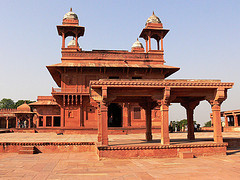
Built in around 1570, by the Mughal Emperor Akbar the Great, Fatehpur Sikri was the new capital of the Mughal Empire and the first planned city of the Mughals.
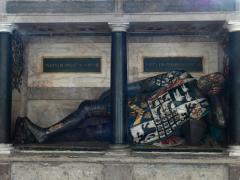
Monument to Robert Steward (d1570) was an ancestor of Oliver Cromwell. The recumbent effigy wears armour with bogus heraldry.