Sarah Baroness Braye Tomb - Stanford-on-Avon, Northamptonshire
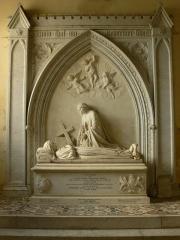
Tomb in memory of Sarah Baroness Braye (d1862) by Mary Thorneycroft ⓘ.
Tomb in memory of Sarah Baroness Braye (d1862) by Mary Thorneycroft ⓘ.
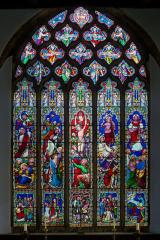
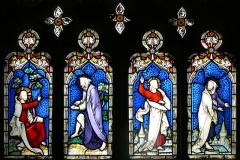
This multi-light stained glass window, dated 1863 and designed by William Wailes, presents a richly structured typological meditation on sacrifice, suffering, and redemption, characteristic of mid-Victorian Anglican theology and narrative glass.
The principal upper sequence depicts the central events of Christ’s Passion and glorification:
The Agony in the Garden
Christ carrying the Cross
The Crucifixion, occupying the dominant central position
The Resurrection
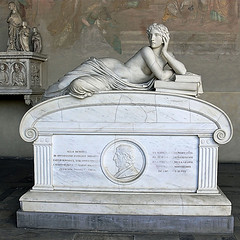
Allegorical figure of Science on the tomb of the physicist Ottaviano Fabrizio Mossott (d1863) in the Camposanto Monumentale, Pisa, by the sculptor Giovanni Duprè.
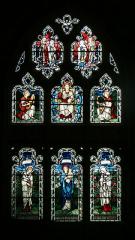
This window by Hardman & Co., illustrates a Salvator Mundi in the typanum, whilst below are three panels depicting St Agnes ⓘ, The Virgin Mary ⓘ, and St Dorothy.
The south aisle west window of Gloucester Cathedral contains this window on the theme of Justice by John Hardman & Co., dated 1865.
This Hardman window from the mid 1860s depicts the resurrection. Christ rises from the tomb with the soldiers on guard recoiling on either side.
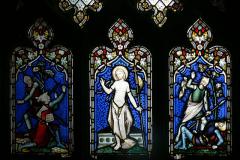
A three light Hardman window depicting the three Mary's at the tomb. The central panel shows the angel, whilst the left are Mary, the mother of James, and Mary of Clopas. The right hand panel depicts Mary of Magdalene ⓘ carrying a vessel of oil.
In the east arcade of the cloisters are two windows depicting the temptation of Christ. These windows were made in the 1860s by John Hardman and Co.
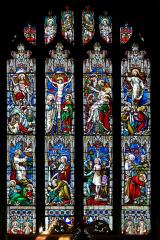
This east window, dated 1866 and designed by William Wailes, is devoted to the Crucifixion and the principal episodes of Christ’s Passion. It exemplifies the mature Victorian narrative window, combining theological clarity with strong colour and carefully ordered figural sequences.
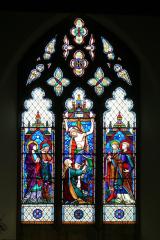
A richly coloured Crucifixion window of 1868–1869 by Heaton, Butler and Bayne, presenting the central mystery of the Passion within a balanced devotional scheme.
Left-hand light:
The Virgin Mary ⓘ stands with Mary Cleophas, their restrained grief expressed through gesture and posture, forming a quiet counterpoint to the drama of the central scene.
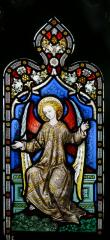
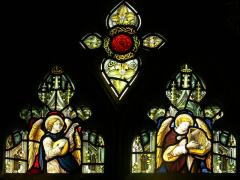
Above the Lavatorium at Gloucester Cathedral, these Hardman windows from 1868 depict a number musical angels.
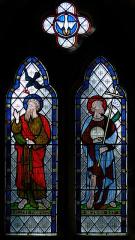
This two-light stained-glass window, dating from the late 1860s, was made by Clayton & Bell ⓘ for the church at Tiffield. It pairs figures of the Old and New Testaments: Elijah the Prophet and St John the Baptist ⓘ, linked typologically through their prophetic witness and ascetic character.
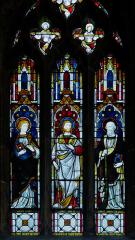
This three-light stained glass window, dated 1869 and made by Burlison & Grylls ⓘ, depicts St John ⓘ, St Philip ⓘ, and St James the Less ⓘ, presented as standing apostles beneath an angelic tracery bearing texts from the Apostles’ Creed. The window forms part of the coherent Victorian apostolic programme at Kings Sutton, combining doctrinal clarity with restrained Gothic revival design.
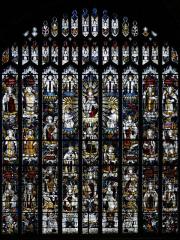
The vast south transept window at Lichfield Cathedral is one of the most imposing works of High Victorian stained glass in the building. Installed between 1869 and 1873 as part of the 19th-century restoration campaign, it was designed and executed by the prolific Gothic Revival studio Clayton & Bell ⓘ. Comprising nine tall lancets crowned by rich tiers of tracery lights, the window forms a complex yet coherent theological cycle centred on the Majesty of Christ and the ranks of heavenly and ecclesiastical witnesses.
This stained-glass window is the Good Samaritan Window at St Mary’s Church, Lutterworth, Leicestershire, designed and made by the firm of Burlison & Grylls ⓘ, one of the foremost English stained glass studios of the late 19th century.
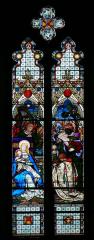
"Adoration of the Magi" by Heaton, Butler & Bayne (1869).
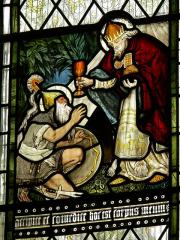
The south window of the chancel at All Saints, Middleton Cheney, contains two important stained-glass panels designed by Ford Madox Brown in 1870, created during his period of work for Morris, Marshall, Faulkner & Co. These windows are among the finest surviving examples of Brown’s contribution to Victorian ecclesiastical glass, characterised by his expressive figures, sculptural modelling, and dense narrative detail.
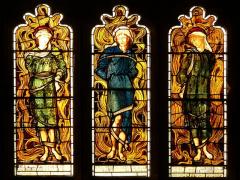
"Three young men in the fiery furnace" Edward Burne-Jones ⓘ (1870).
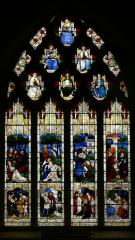
This 5 light east window at St. Leonard, Misterton in Leicestershire is dated 1870.
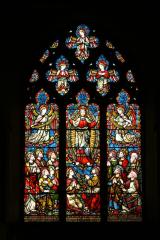
This three-light east window., in All Saints, Braunston, depicts the Ascension of Christ in a clear, vertically organised composition typical of Victorian ecclesiastical stained glass. In the central light, Christ rises heavenwards within a mandorla, his right hand raised in blessing, while the apostles below gather in a semicircle, their varied gestures conveying wonder, devotion, and astonishment at the moment of departure.