PeriodIndex

Tree of Jesse - Saint-Étienne de Beauvais

Tree of Jesse - Saint-Étienne de Beauvais

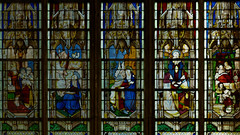
This Tree of Jesse (1522) in St-Étienne, Beauvais is considered to be one of the major works of Engrand Le Prince. Unfortunately the lower part of the window was destroyed in 1793 (year II of the Republic), when the church was used as a store house.


Chapel of the Sacred Heart - Beauvais Cathedral

Chapel of the Sacred Heart - Beauvais Cathedral

The Sacred Heart Chapel in Beauvais Cathedral contains this stained glass window by Engrand Le Prince. It was commissioned in 1522 by Louis de Roncherolles chamberlain and councillor to Francis I of France.


Cleansing the Temple Polychrome Relief - Amiens Cathedral

This richly animated cycle of polychrome reliefs depicts the episode of Christ Cleansing the Temple (Matthew 21:12–13; Mark 11:15–17; Luke 19:45–46; John 2:13–16). Carved in deep relief and originally conceived as a continuous narrative sequence, the scenes unfold across the west wall of the north transept, drawing the viewer into the crowded precincts of the Temple in Jerusalem.


Choir stalls Saint-Jean-Baptiste at Montrésor - France

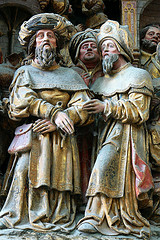
The choir stalls of the collegiate church of Saint-Jean-Baptiste at Montrésor form one of the most eloquent ensembles of Renaissance woodcarving in Touraine. They were made around 1530-1540, when Imbert de Batarnay, seigneur of Montrésor and counsellor to four French kings, endowed the new collegiate foundation he had created in 1521.

Adrien Hénencourt monument - Amiens Cathedral

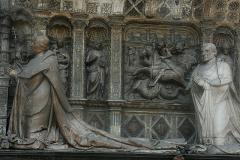
Monument of Adrien Hénencourt (d1530) at Amiens Cathedral. This monument is below the choir screen (1490-1530) depicting the life of St Firmin that canon Hénencourt was responsible for commissioning.

Crucifixion - Montresor, France

Renaissance Crucifixion by Tours school of glass painters

The Crucifixion window in the Church of Saint John the Baptist at Montrésor, in the Indre-et-Loire region of France, is one of the finest surviving examples of early sixteenth-century stained glass in the Loire Valley. Filling a tall Gothic lancet divided into several vertical lights, it unfolds as a vivid narrative of the Passion of Christ, rendered in rich Renaissance color and form.

Pieta by Bertin Duval - Alençon France


Renaissance-era stained glass window depicting the Pieta, created by the master glass painter Bertin Duval in 1530 and installed in the choir of Notre-Dame Church in Alençon

Louis de Brézé Monument - Rouen Cathedral

This monument to Louis de Brézé (d1531) is the work of Jean Goujon (1510-1572) who was commissioned by Diane de Poitiers, Louis wife. Louis was the son of  King Charles VII of France's illegitimate daughter Charlotte de France.

Prior Moore - Worcester Cathedral


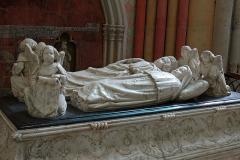
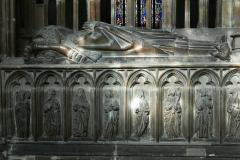
Situated behind the main altar in Worcester cathedral this effigy is said be that of William Moore (1518-1536), the prior of the Benedictine Priory of St Mary's Worcester.


Decapitation of John the Baptist - Saint Romain-sur-Cher


The church at Saint Romain sur Cher was rebult in the C16 and restored in the C19. The north and south walls of the apse are painted with scenes of the Decapitation of John the Baptist and the Baptism of Christ on the north wall, and on the south wall is the Resurrection. Both of these paintings were restored in 1859.


Composite Window - Stoning of St Stephen and Martyrdom of St Catherine

SS Stephen Catherine


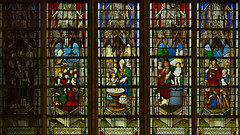
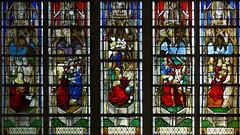
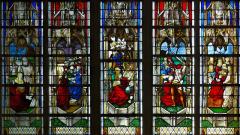
This window is a composite assembly combining fragments of sixteenth-century stained glass with nineteenth-century architectural structures and extensive twentieth-century restoration. The present arrangement consists of five tall lancets surmounted by a unified canopy system reconstructed in 1852, with bases and pedestals also installed at that time.


The Life of St Vincent - Abbey Church of Saint-Ouen, Rouen

Life of St Vincent

This window (c1550) illustrates episodes from the martyrdom of St Vincent of Saragossa, one of the most widely venerated deacons of the early Church. Created by a Rouen atelier in the early sixteenth century, the glass adopts the familiar layout of the Saint-Ouen narrative series: scenes arranged beneath richly architectural Gothic canopies, each panel presenting a distinct moment from the saint’s Passion.


Pages