
Magnificat Window
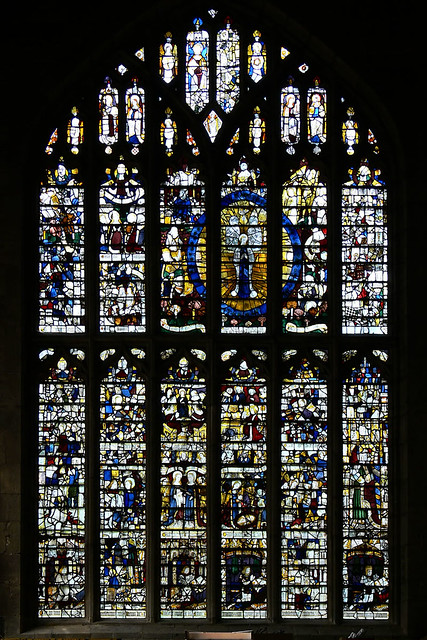
This large stained-glass window in the north transept of Great Malvern Priory was presented to the church in 1501 as a royal gift from Henry VII, and is attributed by the Corpus Vitrearum Medii Aevi ⓘ to glaziers working within the circle of William Twygge and Thomas Woodshawe, on the basis of close stylistic comparison with the east windows at Tattershall Church, a securely documented commission of the later fifteenth century. It is among the most important surviving early-Tudor glazing schemes in England and is traditionally known as the Magnificat Window, after the canticle of the Virgin Mary ⓘ recorded in Luke 1:46–55, which is incorporated within its design.
The window is conceived as a complex narrative and devotional programme, combining scenes from the Life of the Virgin Mary and the Life of Christ. These episodes are arranged across multiple lights and registers, interwoven with ornamental canopies and inscriptions, creating a dense visual meditation on the Incarnation and its fulfilment. The Magnificat text, Mary’s song of praise following the Annunciation, provides the theological framework of the whole scheme, articulating themes of humility, divine mercy, and the reversal of worldly power that were particularly resonant in late medieval devotional culture.
Iconographically, the emphasis on the Virgin aligns closely with contemporary Marian devotion at the turn of the 16th century. The Magnificat itself, with its stress on God’s regard for the “low estate” of his handmaiden and the exaltation of the humble, finds visual expression in the careful juxtaposition of narrative scenes and symbolic motifs throughout the window. The glazing thus functions not simply as biblical illustration, but as a sustained act of praise rendered in glass, colour, and light.
Stylistically, the window reflects the late medieval English tradition at its height, with richly coloured pot-metal glass, strong leading patterns, and figures characterised by expressive gesture and flowing drapery. Although much altered, enough survives to convey the original richness of the scheme and its ambition as a royal commission. The scale and complexity of the window underscore both the importance of Great Malvern Priory at the close of the medieval period and the continuing role of royal patronage in ecclesiastical art under the early Tudors.
The physical condition of the window bears clear witness to its long and eventful history. It has suffered repeated damage over the centuries, notably during the Great Storm of 1703, which caused widespread destruction to church fabric across England. In the 18th century, panes were reportedly broken by stone-throwing boys, a reminder of the vulnerability of stained glass in post-Reformation parish life. Damage to the glazing allowed vegetation to penetrate the structure and enabled birds to enter the building; pigeons were reported to have nested within the transept. Plaster was falling from the walls, indicating prolonged neglect rather than deliberate alteration of the fabric.
Despite this history of neglect and damage, the Magnificat Window remains a work of exceptional significance. Its survival, albeit fragmentary and restored, preserves an important witness to late medieval Marian devotion, early Tudor royal patronage, and the changing fortunes of stained glass in English churches from the Reformation onwards.


