Brunelleschi, Filippo
Filippo Brunelleschi stands at the threshold of the Renaissance. Trained initially as a goldsmith, he became the architect who transformed the visual language of 15th-century Florence. His work reintroduced the structural clarity, proportional harmony, and classical vocabulary of ancient Rome, while his experiments in linear perspective reshaped pictorial space for generations of artists.
Brunelleschi’s career was marked by technical audacity and intellectual ambition. His study of Roman ruins, undertaken with Donatello ⓘ in the early 15th century, informed a radical new architecture based on geometry and measured proportion rather than Gothic verticality.
The Dome of Florence Cathedral
His most celebrated achievement is the great dome (cupola) of Santa Maria del Fiore in Florence (constructed 1420–1436). Designed without traditional centering, the double-shell structure employed herringbone brickwork and innovative engineering solutions. The dome not only solved a major structural problem but also proclaimed Florence’s civic and artistic identity.
Major Works
-
Dome of Santa Maria del Fiore (Florence Cathedral), 1420–1436
-
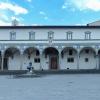
Ospedale degli Innocenti, Florence, begun 1419
-
Basilica of San Lorenzo (Old Sacristy), Florence
-
Pazzi Chapel, Santa Croce, Florence
-
Santo Spirito, Florence
Significance
Brunelleschi is widely credited with formulating the principles of linear perspective, demonstrated experimentally around 1420. Though he left no written treatise, his discoveries were codified by Leon Battista Alberti and disseminated across Europe.
His architecture introduced:
-
Modular planning based on geometric ratios
-
Clear articulation of structural elements
-
Revival of classical columns, pilasters, and round arches
-
Rational, mathematically ordered space
Through these innovations, Brunelleschi established the architectural foundations of the Renaissance.