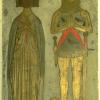
Brass monument makers, London ‘C’
The designation “London ‘C’” is used by modern scholarship to identify an anonymous group of London-based brass engravers responsible for a coherent body of late medieval monumental brasses. The label derives from stylistic analysis rather than documentary evidence and distinguishes this workshop from other contemporary London groups.
Works attributed to the London ‘C’ workshop are characterised by assured engraving, well-proportioned figures, and a controlled but expressive linear style. Drapery is typically rendered with flowing, rhythmic lines, while facial features are simplified yet carefully articulated. Figures often stand beneath architectural canopies or within cusped frames, reflecting the continued influence of Gothic architectural vocabulary.
The workshop produced brasses for both ecclesiastical and lay patrons, including priests, knights, and members of the urban elite. Their output demonstrates the central role of London as a production centre for monumental brasses during this period and illustrates the standardisation of patterns combined with subtle workshop individuality. Although representing a relatively small proportion of London brass production, the workshop conventionally designated London “C” appears to have enjoyed a distinctive patronage profile. As noted by Nigel Saul ⓘ, at the turn of the fourteenth and fifteenth centuries the workshop attracted significant commissions from members of Richard II’s chamber staff, situating its activity within a courtly and administrative milieu closely associated with the royal household.1
- 1.
English Church Monuments In The Middle Ages: History And Representation Oxford, New York 2009.p105.