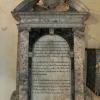
Smith of Warwick
Smith of Warwick refers to the family workshop established by Francis Smith (1672–1738) and continued by his son William Smith (1705–1764), active across Warwickshire, the Midlands, and beyond from the late seventeenth through the mid eighteenth century. The workshop was one of the most prolific and influential provincial centres for architectural and monumental sculpture in early Georgian England.
Founded by Francis Smith, the practice combined masonry, building, and sculpture, supplying complete schemes of church monuments, architectural carving, and decorative stonework. Following Francis Smith’s death in 1738, the workshop continued under William Smith with little disruption, maintaining stylistic continuity and production methods. As a result, many works cannot be securely distinguished between father and son and are conventionally attributed simply to Smith of Warwick.
The output of the workshop is characterised by robust carving, clear architectural organisation, and a restrained ornamental vocabulary aligned with late Stuart and early Georgian taste. Smith monuments are widely distributed and frequently cited in the county volumes of Pevsner as “Smith of Warwick” or “probably Smith of Warwick,” reflecting both the scale of production and the difficulty of precise attribution within a continuous workshop tradition.
Rather than representing individual artistic personalities, the Smith of Warwick workshop exemplifies the role of long-lived provincial practices in sustaining English monumental sculpture outside London. Its work forms an essential backdrop to the development of early eighteenth-century ecclesiastical and architectural sculpture in the Midlands.