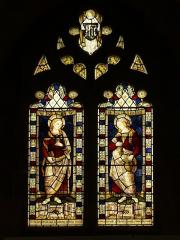
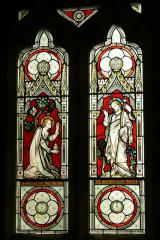
Loaves and Fishes -Tewkesbury Abbey
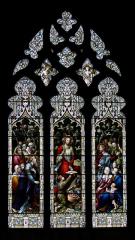
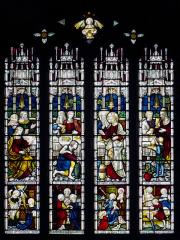
Hardman window (1888) St Philip ⓘ on the right is asking where they can buy bread to feed the crowd
Hardman window (1888) St Philip ⓘ on the right is asking where they can buy bread to feed the crowd

Lobin studios operated from 35 rue des Ursulines in Tour at between 1853 and 1892. The family business was started by Julien Léopold Lobin(1814-1864), and run by his son Lucien Léopold Lobin (1837-1892) after 1864. The company also worked with other glass makers including a long relationship with Jean-Prosper Florence.
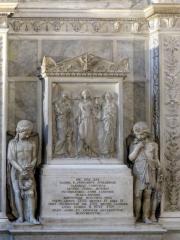
This tomb of Princess Louise of Stolberg-Gedern (d1824) is situated in San Croce Florence
Richard Cockle Lucas (1800–1868) was an English sculptor active during the first half of the 19th century. He is particularly renowned for his portraits and monuments characterized by meticulous naturalism and a strong psychological dimension, departing from the allegorical and heroic conventions inherited from the 18th century.
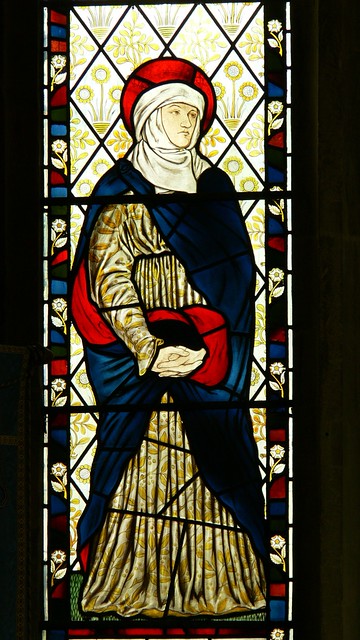
Ford Madox Brown was born on 16 April 1821 in Calais to English parents, and received his artistic training at the Académie des Beaux-Arts in Antwerp, where the rigorous academic tradition left a lasting imprint on his draftsmanship and compositional discipline. Though Brown spent much of his early life moving between the Continent and England, he established himself in London during the 1840s as a painter of historical and moral subjects.
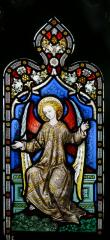
A three light Hardman window depicting the three Mary's at the tomb. The central panel shows the angel, whilst the left are Mary, the mother of James, and Mary of Clopas. The right hand panel depicts Mary of Magdalene ⓘ carrying a vessel of oil.
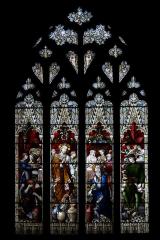
This four-light window, at All Saints Stamford, depicts The Marriage at Cana (John 2:1–11), the first miracle of Christ. Executed by Clayton & Bell ⓘ in the late nineteenth century, it combines the Cana narrative with a Marian-inflected Christological cycle in the predella below.
In the main lights, Christ stands centrally, blessing the water jars as servants draw the newly transformed wine. Mary gestures toward her Son, echoing her words: “Whatsoever he saith unto you, do it.” The surrounding guests express surprise and animation as the miracle unfolds.
This window by Hardman & Co. illustrates the first of Christ's Miracles.
Burlison & Grylls ⓘ window depicting Mary and Martha Clifton on Dunsmore.
Hardman representation of Jesus appearing to Mary of Magdalene ⓘ at the tomb (John 20:17).