19th century church monuments
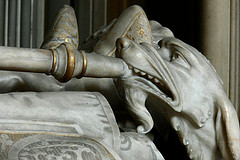
Church brasses, tomb chests, effigies, and sculpture from 1900 - 2000 AD.
Church brasses, tomb chests, effigies, and sculpture from 1900 - 2000 AD.
19th-century tombs (c. 1801–1900) range from restrained memorials to highly elaborate architectural monuments. Influenced by Gothic Revival and Romantic historicism, they emphasize identity, family memory, and renewed Christian symbolism through sculpture, inscription, and material richness.
19th-century wall monuments (c. 1801–1900) are the most prolific and visually varied form of commemoration. Tablets, reliefs, and sculptural ensembles combine revival styles, moral sentiment, and biographical detail, reflecting Victorian attitudes to memory, faith, and social achievement.
This multi-light window of 1891, designed by Christopher Whall, presents a carefully structured theological programme articulated through an early and ambitious example of his independent Arts and Crafts work. Executed shortly after his departure from the Whitefriars studio of J. Powell & Sons, it stands among his first major ecclesiastical commissions undertaken in his own name.
Adoration of the Magi by Herbert Bryans ⓘ.
Alfred Russel Wallace, OM, FRS (8 January 1823 – 7 November 1913), was a British naturalist, explorer, geographer, anthropologist, and biologist whose work played a central role in the development of evolutionary theory. He is best known for independently proposing the principle of natural selection, which led Charles Darwin to publish his own theory in 1859.
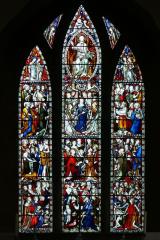
The east window at All Saints, Ladbroke is one of the most densely populated compositions produced by Hardman & Co., containing over eighty individual figures arranged across the lights and tracery. It represents the firm at the height of its High Victorian confidence, where scale, narrative ambition, and visual abundance are combined within a tightly controlled Gothic framework.
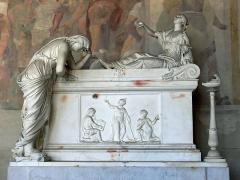
This elegant Neoclassical funeral monument, located in the portico of the Camposanto Monumentale within Pisa's Piazza dei Miracoli, commemorates Anastasia Petri-Schouvaloff (dates uncertain, likely 18th–19th century).
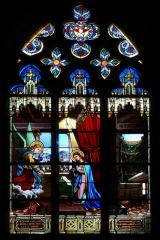
Comparision of two Annunciation windows, by the Julien Fournier Studio, dated 1885 and 1886 in Pontlevoy and Cheverny respectively.

Set in the tracery above the three-light window depicting St Anne, the Virgin Mary ⓘ, and St Elizabeth—designed respectively by Ford Madox Brown (Anne and Elizabeth) and Edward Burne-Jones ⓘ (central Mary)—this Annunciation scene was designed by William Morris in 1880.