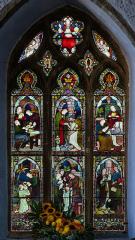
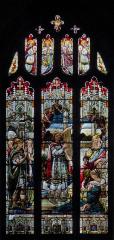
W.C. Buckley memorial windows - Middleton Cheney

Window at Middleton Cheney were designed by Burne-Jones ⓘ (1893) as a memorial to his friend W.C. Buckley.
Window at Middleton Cheney were designed by Burne-Jones ⓘ (1893) as a memorial to his friend W.C. Buckley.
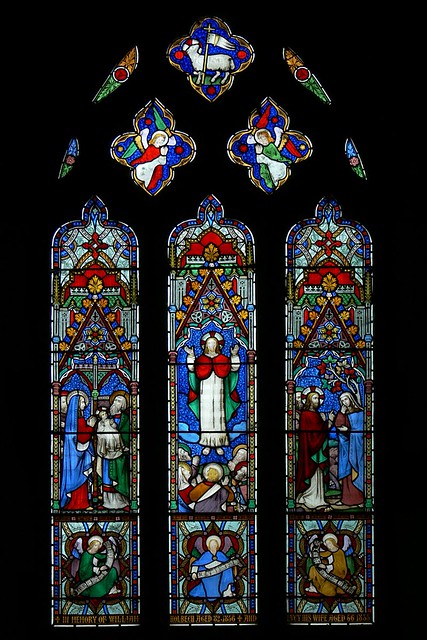
William Wailes (1808-1881) was born in Newcastle and originally started grocery and tea-dealing business. He studied the manufacture of stained glass in Munich in the 1830s, and by 1838 start his own company in Newcastle-upon-Tyne.
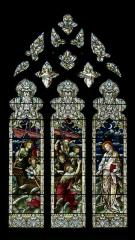
This window by Hardman (1892) is Christ in Glory with the prophets Moses and Elijah to the left and right.
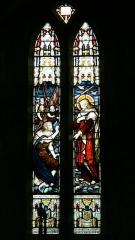
This two-light stained glass window, dated 1895 and designed by Heaton, Butler & Bayne, illustrates the episode of Christ Walking on the Water (Matthew 14:28–31), focusing on the moment of human doubt met by divine rescue.
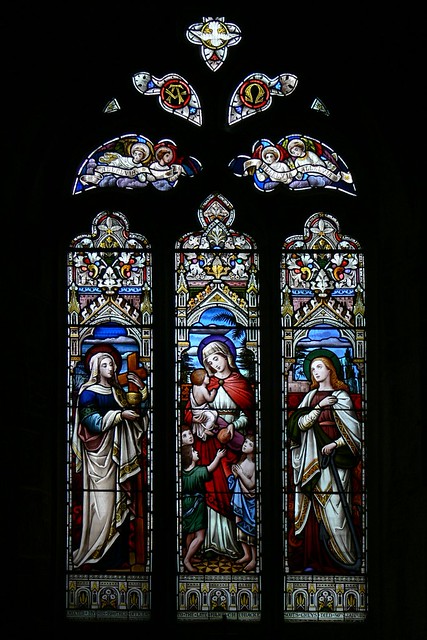
The company began in 1836 as Ward and Nixon, the two worked together for twenty years, exporting windows all over the world. In 1855 they were given the contract for re-glazing of East Window of Lincoln Cathedral. By which time James Nixon started to take less active part in the business and died in 1857.
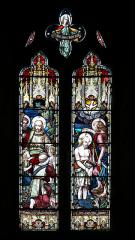
This west window depicts Christ welcoming children and the Baptism of Christ, subjects closely associated with initiation into the Christian life and well suited to a west-end position within the church.
Left-hand light:
Christ is shown receiving children, accompanied by the inscription “Suffer the little children to come unto me” (Mark 10:14). The scene emphasises inclusion, blessing, and the openness of the Christian community.
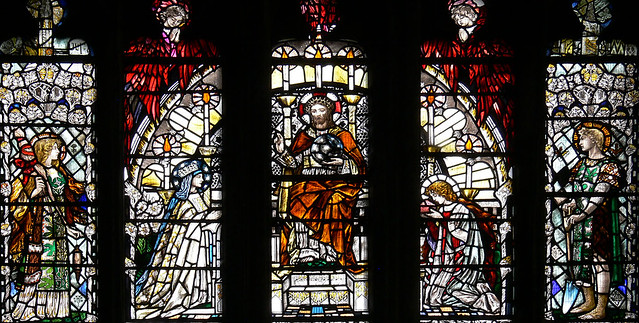
Christopher Whall (1849-1924), studied art at the Royal Academy Schools where he became influenced by the Pre-Raphaelites. After leaving the Royal Academy in 1879 he specialized in stained glass, working for John Powell & sons as a designer, but started his own company when he wanted to learn the whole craft of stained glass making.
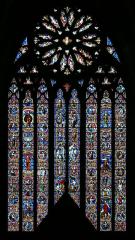
The earliest stained glass window installed by Hardman, in Worcester Cathedral, is the three light Ressurection window installed in the north aisle in 1861. This eight light west window, however, is one of Hardman's larger works in the UK. Designed by George Gillbert Scott, it was installed in 1875, and depicts the creation.
This three-light stained glass window, dated 1877 and designed by Frederick Preedy, illustrates the Works of Mercy as set out in Matthew 25, presenting Christian charity as the visible expression of faith in daily life. The window forms a moral and devotional counterpart to the Passion and sacramental imagery elsewhere in the church.
This three-light stained-glass window, installed in the 1880s at St Mary’s Church, Stamford, depicts David as the “Sweet Psalmist of Israel”, a title drawn from 2 Samuel ⓘ 23:1. The style and architectural treatment align with the later phase of the workshop founded by Michael O'Connor and continued after his death.
In the central light, David stands playing the harp, his figure poised beneath an elaborate Gothic canopy. He is presented not as warrior but as inspired musician, the author of the Psalms, embodying sacred poetry and spiritual consolation.