
Marriage at Cana - Stamford Lincolnshire
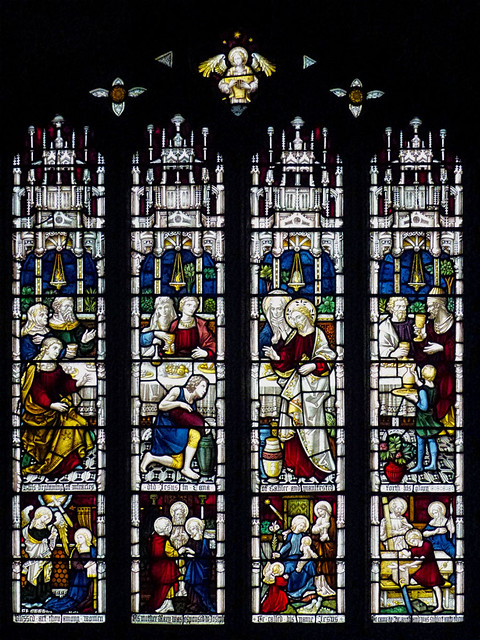
This four-light window, at All Saints Stamford, depicts The Marriage at Cana (John 2:1–11), the first miracle of Christ. Executed by Clayton & Bell ⓘ in the late nineteenth century, it combines the Cana narrative with a Marian-inflected Christological cycle in the predella below.
In the main lights, Christ stands centrally, blessing the water jars as servants draw the newly transformed wine. Mary gestures toward her Son, echoing her words: “Whatsoever he saith unto you, do it.” The surrounding guests express surprise and animation as the miracle unfolds.
The architectural canopies, delicate tracery, and luminous colour palette typify Clayton & Bell’s mature Victorian Gothic style.
Predella Cycle
Beneath the Cana scene runs a sequence of events from Christ’s early life:
-
The Annunciation
Inscription: “Blessed art thou among women.” (Luke 1:42) -
The Marriage to Joseph
Inscription: “His mother Mary was espoused to Joseph.” (Matthew 1:18) -
The Nativity
Inscription: “He called his name Jesus.” (Matthew 1:25) -
The Holy Family in Nazareth (Carpenter’s Workshop)
Christ assisting Joseph in carpentry — notably shaping a beam suggestive of the Cross — with the inscription reflecting Luke 2:51:
“He came to Nazareth, and was subject unto them.”
This progression moves from Incarnation to hidden life, culminating above in the public manifestation of divine glory at Cana.
Theological Structure
The predella emphasises:
-
Obedience and humility (Nazareth)
-
Incarnation (Nativity)
-
Marian mediation (Annunciation, Cana)
The workshop scene, with the young Christ shaping timber reminiscent of the Cross, introduces typological foreshadowing of the Passion.
Style
High Victorian Gothic Revival
c. late 1880s–early 1890s
Studio hallmark features:
-
Crisp canopy architecture
-
Clear figure modelling
-
Narrative precision
-
Balanced jewel-toned palette
