Healing the Sick - Tewkesbury Abbey
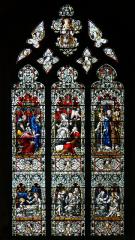
Hardman window of 1888 shows Jesus healing the sick.
Hardman window of 1888 shows Jesus healing the sick.
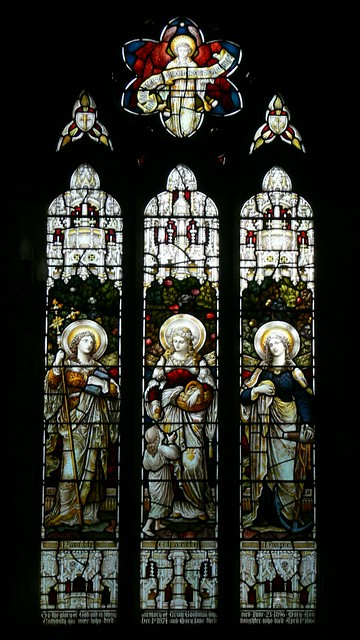
Clement Heaton, a glass painter, and James Butler, a lead glazier, went into partnership in 1855 to make stained glass. Initially they shared premises with, and provided technical assistance to Clayton & Bell ⓘ. Robert Turnill Bayne, a Pre-Raphaelite artist, joined the company in 1862, and became their chief designer.
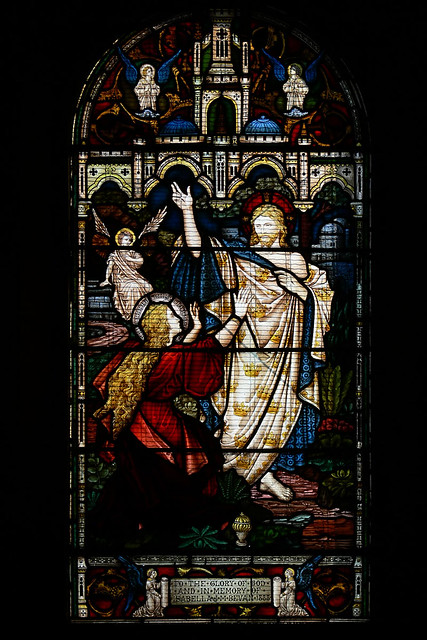
A. O. Hemming (Alfred Octavius Hemming, 1868–1930) was an English stained-glass artist active in the late Victorian and Edwardian periods. He trained within the Birmingham milieu and is closely associated with the tradition established by Hardman & Co., for whom he worked early in his career, before establishing himself as an independent designer and maker.
Henry Holiday (1839–1927) was an English painter, illustrator, sculptor, and one of the most significant stained-glass designers associated with the later Pre-Raphaelite circle. Although not a member of the original Pre-Raphaelite Brotherhood, he was closely connected to its ideals and leading figures, including Dante Gabriel Rossetti, William Morris, and Edward Burne-Jones ⓘ, and shared their commitment to medievalism, craftsmanship, and imaginative design.
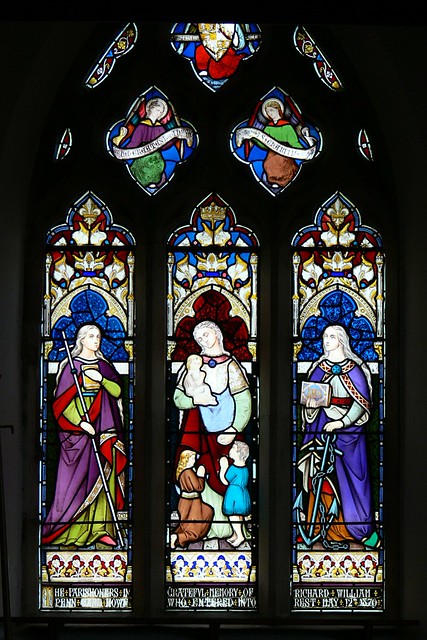
Holland of Warwick, located on St John's road Warwick were stained glass makers during the second half of the 19th century. In the 1850s they were one of the main manufacturers in the depressed town. At this time they were a 'stained glass and decorative painting establishment' that specialized in the 'design for monumental and baronial windows, enamelled and encaustic painting, gilding, imitations of wood'. They also employed Clement Heaton as a designer in the early 1850s before he moved to London to start his own company with James Butler in 1855.
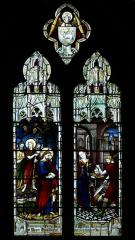
This Hardman & Co. (1892) window depicts Jesus in discussion with the temple Elders
A narrative stained-glass window of 1885 by Burlison & Grylls ⓘ occupies the east bay of the north aisle.
Jones & Willis was a Birmingham-based stained-glass firm active from the mid-nineteenth century into the early twentieth century. The partnership was established by John Jones and William Willis and became known for ecclesiastical glazing across England and Wales.
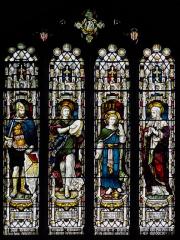
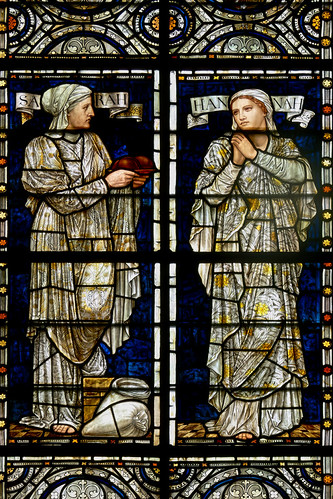
This four-light window of 1895, at All Saints Stamford, executed by Heaton, Butler & Bayne, depicts four Old Testament figures associated with leadership, praise, and faithful dedication: Joshua, Miriam, Samuel ⓘ, and Hannah.
From left to right:
Joshua, warrior and successor of Moses, stands armed, bearing sword and shield, representing steadfast obedience and divine commission.
Miriam, sister of Moses, holds a tambourine, recalling her song of triumph after the crossing of the Red Sea (Exodus 15).
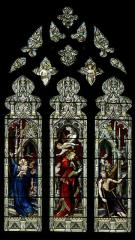
The south aisle west window of Gloucester Cathedral contains this window on the theme of Justice by John Hardman & Co., dated 1865.