Holiday, Henry
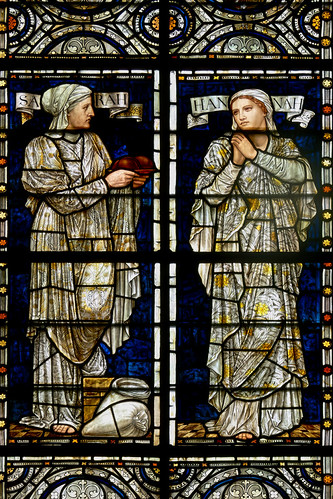
Henry Holiday (1839–1927) was an English painter, illustrator, sculptor, and one of the most significant stained-glass designers associated with the later Pre-Raphaelite circle. Although not a member of the original Pre-Raphaelite Brotherhood, he was closely connected to its ideals and leading figures, including Dante Gabriel Rossetti, William Morris, and Edward Burne-Jones ⓘ, and shared their commitment to medievalism, craftsmanship, and imaginative design.
Holiday entered the Royal Academy Schools in 1854, at the age of fifteen, and from an early stage demonstrated a versatility that extended across painting, sculpture, book illustration, and decorative arts. His artistic outlook was shaped by direct contact with Pre-Raphaelite artists and by a lifelong interest in archaeology, geometry, and the structural principles of medieval art.
His involvement with stained glass began in the early 1860s, when he started designing windows for James Powell & Sons (Whitefriars). Over the following decades, Powell’s became the principal outlet for his stained-glass designs, through which he developed a distinctive visual language characterised by clarity of drawing, restrained colour, and a strong sense of architectural order. His figures are typically calm and hieratic, with carefully balanced compositions that reflect both medieval precedent and modern design discipline.
During the 1860s, Holiday also produced designs for other major firms, including Lavers & Barraud and Heaton, Butler & Bayne, contributing to the wider dissemination of Pre-Raphaelite influence within Victorian ecclesiastical glazing. Unlike Burne-Jones, whose stained glass is marked by lyrical richness, Holiday’s work is notable for its intellectual precision and concern for structural coherence.
Although stained glass remained an important part of his practice, Holiday never confined himself to a single medium. He continued to work extensively as a painter and illustrator, producing well-known designs for books, murals, and decorative schemes. From the 1890s onward his stained-glass output became less prolific, but his influence persisted through his writings, teaching, and the example of his work.
Henry Holiday’s contribution to stained glass lies in his synthesis of Pre-Raphaelite ideals with a disciplined, architectural approach to design. His windows occupy a distinctive position within late Victorian stained glass, combining artistic seriousness with structural restraint, and form an important bridge between early Pre-Raphaelitism and later Arts and Crafts developments.