East Window - Guilsborough, Northamptonshire

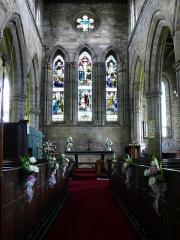
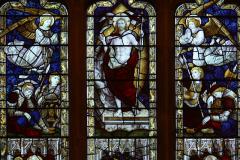
This east window at Guilsborough Northamptonshire, was designed by Edward Burne-Jones ⓘ in 1879.
This east window at Guilsborough Northamptonshire, was designed by Edward Burne-Jones ⓘ in 1879.
This 5 light east window at St. Leonard, Misterton in Leicestershire is dated 1870.
This stained-glass window (1880-1890) from St Nicholas’ Church, South Kilworth, Leicestershire, is the east window designed and made by Burlison & Grylls ⓘ, one of the leading English stained-glass firms of the late 19th century.
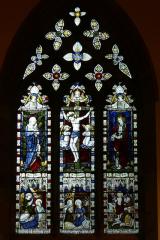
A richly coloured Crucifixion window of 1868–1869 by Heaton, Butler and Bayne, presenting the central mystery of the Passion within a balanced devotional scheme.
Left-hand light:
The Virgin Mary ⓘ stands with Mary Cleophas, their restrained grief expressed through gesture and posture, forming a quiet counterpoint to the drama of the central scene.
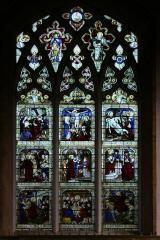
The east window at Breedon-on-the-Hill presents a six-scene typological scheme (type–antitype), pairing episodes from the Old Testament with their fulfilment in the life of Christ. The arrangement emphasises continuity between Mosaic law, patriarchal obedience, and the Passion.
East window by Burlison & Grylls ⓘ. Holy Cross, Byfield.
East window at Old Arley by Burlison & Grylls ⓘ. In the lower left panel St. Wilfred holds a model of this church.
Triptych by Noël Lavergne depicting the Nativity, crucifixion, and resurrection.
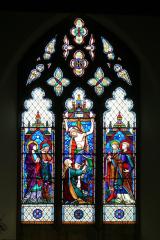
The east window at St Peter’s ⓘ, Dunchurch presents a solemn and carefully ordered depiction of the Crucifixion, arranged across three principal lights beneath an elaborate tracery scheme. The central light is dominated by Jesus Christ crucified, shown frontally against a darkened ground. His body is rendered with restrained naturalism, the vertical emphasis of the cross reinforced by architectural forms suggestive of the heavenly Jerusalem, underscoring the redemptive meaning of the Passion.
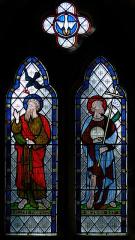
This two-light stained-glass window, dating from the late 1860s, was made by Clayton & Bell ⓘ for the church at Tiffield. It pairs figures of the Old and New Testaments: Elijah the Prophet and St John the Baptist ⓘ, linked typologically through their prophetic witness and ascetic character.