PeriodIndex

The Intimate Madonna in Renaissance Florence: Devotion, Tenderness, and the Domestic Image

In fifteenth-century Florence, the image of the Virgin and Child underwent a quiet revolution. From the solemn, hieratic figures of late Gothic piety, the Madonna became an image of tender humanity, no longer distant and majestic, but immediate, emotional, and profoundly relatable. This transformation mirrors a broader shift in Renaissance devotion: the movement of sacred experience from church to home, from the grandeur of the altar to the intimacy of domestic life.

St. Michael


The archangel St. Michael, is the principal angel and field commander of the Army of God. His name is the war-cry of the good angels in the battle fought in heaven against Satan and his followers. He is often depicted triumphant over the enemy.


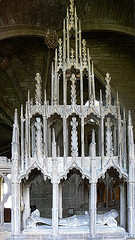
Richard de Beauchamp, 1st Earl of Worcester - Tewkesbury Abbey

This two storied tomb for Richard de Beauchamp, 1st Earl of Worcester (d1421) was built in 1430 by his wife Lady Isabel le Despenser, the great grand-daughter of Edward III. It was probably meant to contain priant figures of both Richard, Isabel, and her second husband Richard de Beauchamp, 13th Earl of Warwick, who was her first husband's cousin.


Marmousets Portal Tympanum - Saint-Ouen, Rouen


The Marmousets Portal Tympanum is a late Gothic sculpture adorning the Porche des Marmousets (Portal of the Marmousets) is the main pedestrian entrance to the Abbey Church of Saint-Ouen in Rouen, Normandy, France. This Flamboyant Gothic portal, primarily honors the Virgin Mary, dates to around 1430 and was crafted by the master sculptor Alexandre de Berneval, and is located at the south transept.

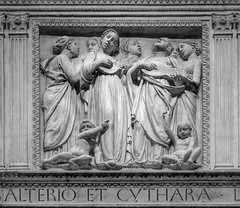
Luca della Robbia, Cantoria (1431–1438) - Florence

Girls Holding Hymnals and Singing

Between 1431 and 1438, the Florentine sculptor Luca della Robbia carved in marble one of the most radiant celebrations of music and childhood in the early Renaissance, the Cantoria, or singing gallery, originally made for the north singing gallery of Florence Cathedral.

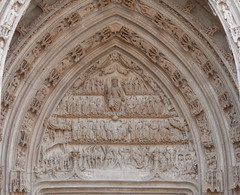
Tympanum - Saint-Maclou Rouen


The tympanum above the central porch, of Saint-Maclou in Rouen depicts Christ in Majesty at the Last Judgement in four registers.

15th century wooden Apostles - Dunstable Priory

15th century wooden Apostles - Dunstable Priory

These carved oak Apostles at Dunstable Priory form part of the structural and iconographic programme of the timber roof, functioning as corbels supporting arched braces or hammer-beams. Oak, the standard and most durable timber for English ecclesiastical roofs, was universally favoured for such work, allowing both structural strength and detailed carving.


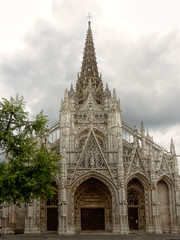
The Western Façade of Saint-Maclou, Rouen


Constructed between 1437 and 1521, the Church of Saint-Maclou occupies a central place in Rouen’s urban and spiritual landscape. The façade, rising before the narrow medieval streets, is one of the most refined expressions of the Flamboyant Gothic, a style characterized by intricate tracery, dynamic ornament, and an almost musical rhythm of line.

Presentation in the Temple (cell 10)


This fresco (1438-1443) by Fra Angelico 1438-1443) depicting the Presentation in the Temple is in cell 10 of the San Marco monastery in Florence.

Scourging of Christ (cell 4)


This fresco of the "Scourging of Christ" is by Fra Angelico in cell 4 of the San Marco monastery.


Mocking of Christ (cell 7)


In cell 7 of San Marco monastery a fresco, by Fra Angelico assisted by Benozzo Gozzoli, depicts a blindfolded Christ who is enthroned holding a cane and a globe.

Lamentation (cell 2)


Lamentation (1438-1443) over the body of Christ, is by Fra Angelico.

Monk Cells with Frescos

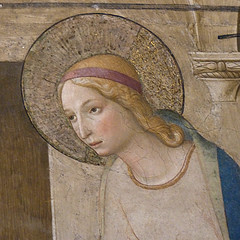
Virgin Mary by Fra Angelico


The upper floor of the San Marco Monastery contains the monk cells, which were mostly painted by Fra Angelico.

Transfiguration (cell 6)


This fresco by Fra Angelico depicts the Transfiguration of Christ, one of the most radiant and spiritually charged scenes in the Gospel narrative. At the center, Christ stands upon a rocky elevation, enveloped in a great mandorla of divine light, his white garments gleaming with celestial brilliance.


Resurrection (cell 8)

Ressurection by Fra Angelico


This fresco (1438-1443) in cell 8 of the San Marco monastery is by Fra Angelico.

Touch Me Not (cell 1)

Touch Me Not


This fresco by Fra Angelico in cell 1 of the San Marco Monastery illustrates the encounter between Mary Magdalen and Christ after the ressurection.

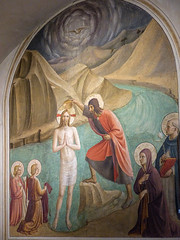
Baptism of Christ (cell 24)

Baptism of Christ fresco

This fresco by Fra Angelico, painted between 1438 and 1443 for the Dominican monastery of San Marco, presents the Baptism of Christ with the clarity, stillness, and devotional intensity characteristic of the artist’s mature period. Set against a serene, winding Jordan River and a stark, mountainous landscape, the composition emphasises the humility of the moment and the contemplative ethos of the monastery for which it was made.

Coronation of the Virgin (cell 9)


This fresco by Fra Angelico 1438-1443) depicting the Coronation of the Virgin is in cell 9 of the San Marco monastery in Florence.

Pages