Ascension, Descent into Hell

These panels from the 'Magnificat' window (1501) at Malvern Priory depict the Archangel Michael on the left. On the top right is Jesus ascent into Heaven, whilst the bottom right panel shows the damned descent into hell.
These panels from the 'Magnificat' window (1501) at Malvern Priory depict the Archangel Michael on the left. On the top right is Jesus ascent into Heaven, whilst the bottom right panel shows the damned descent into hell.
This window in the North transept of Great Malvern Priory was a gift from Henry VII in 1501. Containing scenes from the life of the Virgin Mary and the life of Christ., it is known as the Magnificat window because it contains the Song of Mary from Luke 1:46-55.
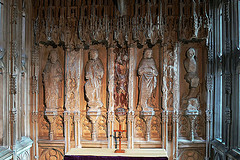
This chantry chapel to Arthur Tudor, covered in tracery and sculptures, was built in 1504. The chest tomb of the 15 year old Prince fills the chapel.
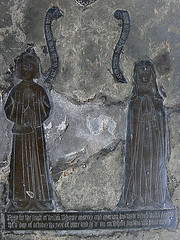
Monumental brass dedicated to William Thorpe (d1504) and his wife Marion. Two figures 2ft 1in in height, with scrolls and inscription.

This Tree of Jesse in the church of St Godard Rouen, is the work of Arnoult de Nimégue (1506).
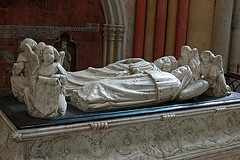
The Tomb of the Children of France is a traditionally attributed to Michel Colombe (c. 1430–1515), one of the foremost French sculptors of the late Gothic and early Renaissance periods, and is widely regarded as one of Michel Colombe’s most touching and refined works.
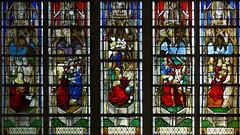 The south aisle of the nave at Saint-Ouen preserves one of the most varied yet coherent hagiographic ensembles in the church’s glazing programme. Although the windows today comprise mixtures of sixteenth-century fragments, nineteenth-century architectural refitting, and extensive twentieth-century restoration, they collectively articulate a single, sustained theme: the commemoration of exemplary saints whose lives, virtues, and martyrdoms offered models for Christian devotion.
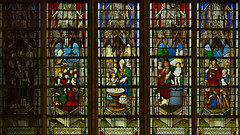
This window forms part of the late-medieval glazing cycle devoted to St Austremoine (St Austremonius), traditionally regarded as one of the missionary bishops sent from Rome to evangelise Gaul. The panels adopt the rich narrative style characteristic of Rouen workshops in the early sixteenth century, combining brightly modelled figures, deep architectural canopies, and landscape backdrops that open the narratives into broad, coherent sequences.
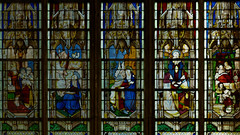
This window narrates episodes from the apocryphal infancy cycle concerning St Anne and St Joachim, parents of the Virgin Mary. Executed in the early sixteenth century by a Rouen workshop, the glass combines dense architectural canopies with clear, compartmentalised scenes, allowing the viewer to follow the story across multiple lights.

This image shows the Virgin and Child of Chartres Cathedral, commonly known as the Black Madonna of Chartres (Notre-Dame du Pilier). It is one of the most venerated Marian sculptures in France and a central focus of devotion within the cathedral. It was commissioned in 1508 as a black wooden copy of the 13th century silver Madonna that stood on the main altar at Chartres Cathedral.
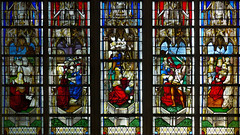
This window (c1508) depicts key moments from the life and martyrdom of St Catherine of Alexandria, a learned noblewoman whose legend was widely celebrated in late-medieval Europe. The glazing, produced by a Rouen workshop in the early sixteenth century, follows the characteristic format of the Saint-Ouen cycles: tightly framed narrative scenes beneath elaborate Gothic canopies, enriched with vivid colour and detailed architectural settings.
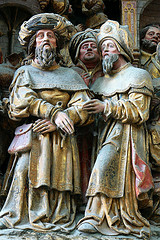
Polychriome reliefs telling the story of St James the Greater, and the conversion of Philetus and Hermogenes. Amiens Cathedral 1511.
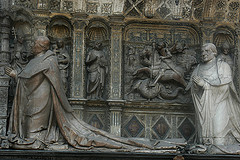 Started in 1515, and completed in 1525, this tomb is the work of the Roullant Le Roux, Rouen cathedral's master mason of the time. It is a memorial to the French cardinal and archbishop of Rouen George d'Amboise (d1510), the other figure is his nephew George d'Amboise (d1550) who became archbishop of Rouen on his uncle's death.
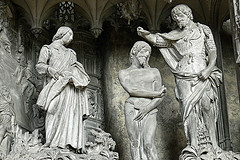 Above the choir screen at Chartres Cathedral are some 40 sculpted reliefs of biblical scenes, and other scenes from the life of the Virgin Mary. The scenes were sculpted by some of the best artists in France and were commissioned at different times over a 200 year period from 1510 to 1720.
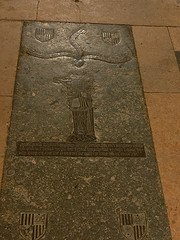
Brass of Thomas Knightley (1516).
 This tomb in the South choir contains the effigy of Bishop Richard Mayew (d1516) under an elaborate canopy, and with weepers around the base. The weepers are thought to represent saints and were damaged during the reformation.
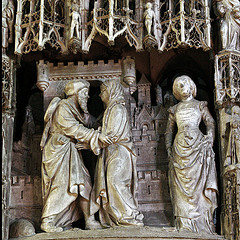
The first sequence of sculpture around the choir screen, starting at the western end of the south ambulatory, is the work of Jehan Soulas from 1519-1521. Sculpted from the hard limestone from the Tonnerre quarry, they consist of scenes from the Gospel of James, depicting the annunciation of the Virgin Mary to Joachim and St Anne, the birth of Mary, and the presentation of Mary in the temple.
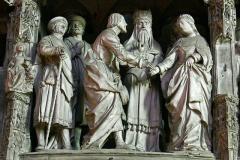
This second sequence of sculpture on the choir screen, starting at the western end of the south ambulatory, is the work of Jehan Soulas from 1520-1535. Sculpted from the hard limestone from the Tonnerre quarry they consist of scenes from the Gospel of James, depicting the marriage of the Virgin Mary to Joseph, the annunciation, and the visitation.

This third sequence of sculpture on the choir screen, starting at the western end of the south ambulatory, is the work of Jehan Soulas from 1521-1535. Sculpted from the hard limestone from the Tonnerre quarry, this consist of scenes depicting the Nativity, Circumcision, and Epiphany.
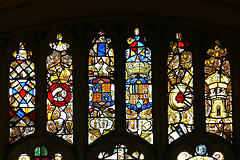
Set within the tracery lights of the great east window at St Peter’s, Coughton, these panels form part of a distinguished group of Tudor heraldic glass. At the centre are the royal arms of Henry VIII, impaled with those of Catherine of Aragon, enclosed by the initials H and K and surrounded by the Tudor emblems of the rose, portcullis, and crown. The inclusion of Catherine’s arms confirms that the glass was installed before the annulment of their marriage in 1533, most likely during the first decade of Henry’s reign.