Crucifixion - Whilton, Northamptonshire
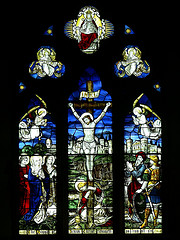
Late 19th to early 20th century east window depicting the Crucifixion by Burlison & Grylls at Whilton, Northamptonshire.
Late 19th to early 20th century east window depicting the Crucifixion by Burlison & Grylls at Whilton, Northamptonshire.
Burlison & Grylls window depicting Mary and Martha Clifton on Dunsmore.
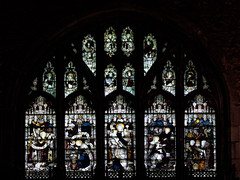
This east window at St. Peter's Church in Market Bosworth, was created by Charles E. Kempe in 1900 (with later contributions from the Kempe and Tower studio)
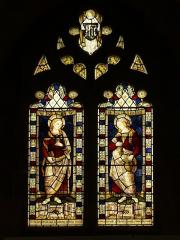
This south chancel window at Wolston, designed by Herbert Bryans, is a two-light composition dated by inscription to 1902 and belongs to Bryans’s early independent period following his departure from the Kempe studio.
The upper lights present two standing figures beneath tall Gothic canopies, arranged as a typological pairing concerned with prophecy and fulfilment.
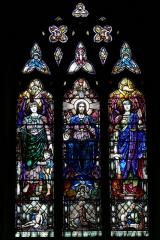
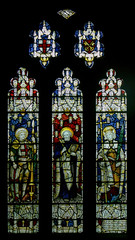 This stained glass window by Charles Eamer Kempe, at St Peter's Market Bosworth Leicestershire, is an example of late Victorian Gothic Revival art, depicting Saints George, Peter, and Margaret in three tall, richly colored panels. Each saint stands beneath an elaborate architectural canopy, rendered in delicate tracery and glowing jewel tones that catch and filter the light with remarkable depth.
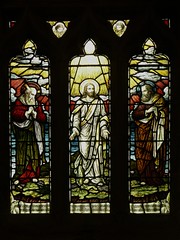
This three-light window (1906-1910) depicts the Transfiguration of Christ on Mount Tabor, a subject rendered with characteristic clarity and luminosity by John Hardman & Co. Christ stands in the central light, enveloped in rays of golden light and dressed in shining white garments. The rocky ground beneath him and the stylised clouds behind create the sense of elevation associated with the biblical account.
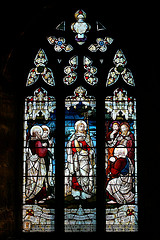
Memorial Window to William Walter Slye by CE. Kempe (1906) - All Saints, West Haddon.
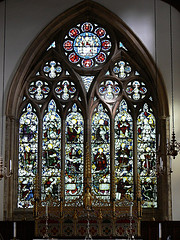
East window by Kempe c1907.

This tomb of Canon John Gylby Lonsdale (1907) at Lichfield Cathedral was made by Farmer and Brindley.
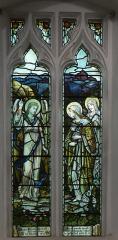
1908 stained glass window by Powell & sons (Whitefriars) depicting an angel greeting the two Mary's in front of the tomb.
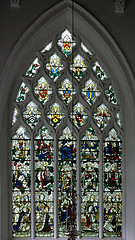
This Tree of Jesse window by Kempe and Tower in the Lady Chapel at Higham Ferrers. It is undated but is judging by the company logo of a black tower superimposed on the wheatsheaf, it is must be after Kempe's death in 1907.
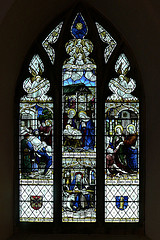
The two windows in the north wall of the chancel in the Saxon church of All Saints, Brixworth are by Burlison & Grylls, dated 1913 and 1915, they are from the first quarter of the 20th century.

Two Kempe and Tower windows from 1914. The first shows St Luke, Virgin and Child, and St John the Evangelist. The upper lights of the second window shows the Epiphany whilst the bottom light depict the Presentation in the Temple.
This two-light stained-glass window depicting the Three Marys at the Tomb, dated 1917, is attributable to Burlison & Grylls and belongs to the firm’s late ecclesiastical output during the First World War period.
The composition presents the moment immediately following the Resurrection, as described in the Gospels, when the holy women come to the tomb and receive the angelic announcement that Christ has risen.

Tomb of Lewis Clayton (d1917) who became Suffragan Bishop of Peterborough in 1903.
This memorial stained-glass window, executed c. 1918 by Arild Rosenkrantz, commemorates Arthur James (d. 1918) and is installed in the parish church at Churchover, Warwickshire. The date and dedication place the work firmly within the immediate aftermath of the First World War, a context that strongly informs both its iconography and emotional tenor.
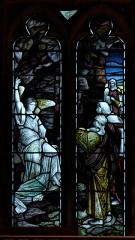
This stained-glass window in the north aisle of All Saints’ Church, Naseby depicts the Angel at the Tomb, witnessed by Mary Magdalene and Mary Clopas, and is attributable to William Morris Studios (Westminster).
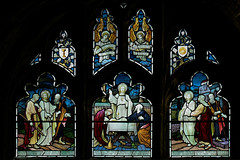
The Emmaus window by Heaton, Butler & Bayne, created in 1925, is a stained-glass triptych set in a South chancel window at Market Bosworth. Made by the London firm known for its Victorian and Pre-Raphaelite style, it depicts the biblical Supper at Emmaus across three panels.
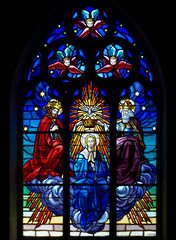
Between 1929 and 1932 the Parisian atelier Mauméjean Frères created a vivid sequence of stained-glass windows for the church of Notre-Dame, Déols. The cycle traces key moments in the lives of the Virgin Mary and Christ, from the Nativity and Annunciation through the Visitation and the miracle at Cana, and finally to the Crucifixion, Resurrection, and the heavenly Coronation of the Virgin.