
Crucifixion - Whilton, Northamptonshire
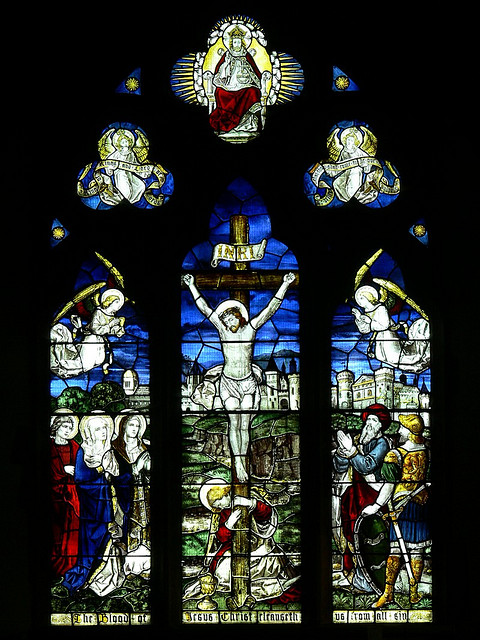
This east window presents a compact yet richly articulated Crucifixion composition, arranged across three principal lights beneath a tier of tracery lights. The scheme balances narrative clarity with devotional focus, typical of late-Victorian Gothic Revival glass, and demonstrates Burlison & Grylls ⓘ’ characteristic clarity of drawing, strong colour harmonies, and careful architectural setting.
Central light
The Crucifixion dominates the centre, with Christ shown on the cross against a deep blue, horizontally banded sky. The figure is elongated and calm, the head inclined in death, emphasising sacrificial stillness rather than physical agony. At the foot of the cross kneels Mary Magdalene ⓘ, embracing the shaft in a posture of penitence and devotion. Her flowing hair and red garments provide a strong chromatic counterpoint to the pale body of Christ and the cool blues of the background. A distant townscape anchors the scene in a symbolic Jerusalem, rendered with restraint so as not to distract from the central act of redemption.
Left light
The left-hand light depicts the women at the tomb, traditionally identified as two of the Marys. Shown in quiet conversation and contemplation, their gestures suggest the dawning realisation of the Resurrection. Their sober, harmonised garments and composed expressions create a narrative pause, balancing the drama of the Crucifixion with the promise implicit in the empty tomb.
Right light
On the right, the Good Centurion and Joseph of Arimathea are shown as witnesses and participants in the Passion’s aftermath. The centurion, recognisable by his military attire, embodies recognition and confession, while Joseph’s dignified bearing reflects his role as the honourable custodian of Christ’s body. Together they represent faith discovered through encounter, complementing the penitential devotion of Mary Magdalene and the expectant grief of the women at the tomb.
Tracery
Above, the tracery lights reinforce the theological message of the window, drawing the eye upward from the historical narrative to its divine significance. The arrangement integrates seamlessly with the main lights, completing a vertical movement from sacrifice to heavenly authority.
Overall, the window exemplifies Burlison & Grylls’ mature ecclesiastical work of the 1880s: clear iconography, disciplined composition, and a restrained emotional register designed to support liturgical contemplation rather than overwhelm it.
