
Richard Colt Hoare
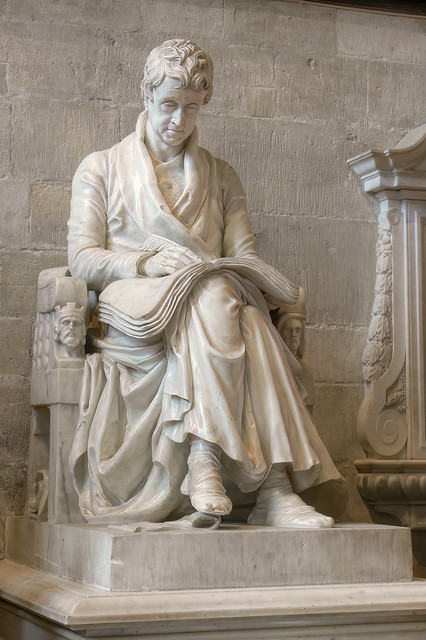
This sculpted monument commemorates Sir Richard Colt Hoare (d1818) and is located in Salisbury Cathedral. It was carved by the sculptor Richard Cockle Lucas ⓘ, one of the most distinctive British sculptors of the early nineteenth century.
Hoare is shown seated, absorbed in the act of reading and writing. A large open manuscript rests across his knees, presenting him not as a figure of rank or authority but as an active scholar. His contemporary dress is rendered with close attention to texture and fall, reinforcing the sense of immediacy and naturalism.
The composition avoids heroic gesture or allegorical accompaniment. Hoare’s body inclines slightly forward, his head lowered and gaze focused, conveying concentration and intellectual labour. The sculpted chair, enriched with carved heads, lends a quiet gravitas to the scene without distracting from the sitter’s reflective pose.
Rather than celebrating title or lineage, the monument foregrounds Hoare’s antiquarian and scholarly achievement. Known for his pioneering studies of Britain’s ancient landscape and monuments—particularly those of Wiltshire—the sitter is memorialised through the tools of learning and inquiry, emphasising knowledge and observation as enduring virtues.
Through its restrained realism and rejection of symbolic excess, the monument exemplifies early nineteenth-century developments in English funerary sculpture, where intellectual virtue, private study, and moral seriousness replaced Baroque drama. Within Salisbury Cathedral, it forms a revealing counterpart to contemporary memorials to diplomats and statesmen, expanding the social and cultural range of commemorated achievement.
