
Index of Renaissance all
The Apostles in Art: Witness, Memory, and Transformation

The Cathedral of St Stephen, Bourges contains a large number of medieval and renaissance stained glass. The glass panels date from 1210 - 1620 and represents Saints, Apostles, Prophets, and Bible stories.

Attributed to Buonamico Buffalmacco this depiction of the Last Judgement, in the Camposanto of Pisa, was created between 1345-1340.


Frescos depicting the annunciation.

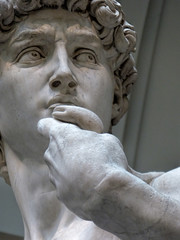
Renaissance sculpture, flourishing from the 14th to the early 17th century, marked a revival of classical antiquity and humanism, centered primarily in Italy, with Florence as its epicenter. Emerging from the medieval Gothic style, it sought to emulate the idealized forms and balanced proportions of ancient Greek and Roman art, while infusing a newfound focus on naturalism and individual expression.
A common subject painted in medieval churches where scenes of the "Last Judgment" or "Doom". Often they would be painted above the chancel arch. A central figure of risen Christ with the instruments of the passion would be painted, or a crucifixion with the Virgin Mary and St John the Evangelist.

Painted between 1425 and 1427 by Masaccio for the Brancacci Chapel in Santa Maria del Carmine, this fresco depicts Saint Peter healing the sick as his shadow falls upon them. The scene forms part of the chapel’s cycle illustrating the life of Saint Peter.
The work exemplifies Masaccio’s revolutionary approach to space, light, and human presence.
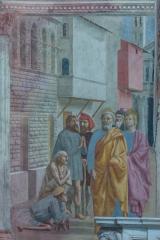
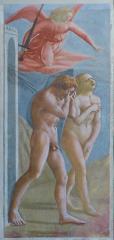
Fresco painting by Masaccio in the Brancacci Chapel in the church of Santa Maria del Carmine, Florence. This panel was painted at the same time as the panel depicting the "The Temptation of Adam and Eve" by Masolino on the opposite wall. Masolino and Masaccio, were both prominent 15th-century Italian painters, and worked together on the Brancacci Chapel frescoes, offering a clear basis for comparison.
The Prato pulpit was commissioned by the Operai del Duomo di Prato for the exterior corner of the cathedral, specifically to display the Sacra Cintola (Holy Belt of the Virgin Mary), Prato’s most treasured relic.

Between 1431 and 1438, the Florentine sculptor Luca della Robbia carved in marble one of the most radiant celebrations of music and childhood in the early Renaissance, the Cantoria, or singing gallery, originally made for the north singing gallery of Florence Cathedral.

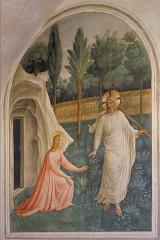
This fresco by Fra Angelico in cell 1 of the San Marco Monastery illustrates the encounter between Mary Magdalen and Christ after the ressurection.
This fresco by Fra Angelico 1438-1443) depicting the Coronation of the Virgin is in cell 9 of the San Marco monastery in Florence.

This images of Christ Carrying the Cross is in cell 28 of the San Marco convent.

In the Nativity scene from Cell 5, Fra Angelico presents a serene and deeply devotional vision of the birth of Christ. The composition centers on the Holy Family, Mary, Joseph, and the infant Jesus, surrounded by an atmosphere of quiet reverence.

This fresco (1438-1443) by Fra Angelico 1438-1443) depicting the Presentation in the Temple is in cell 10 of the San Marco monastery in Florence.

This Annunciation (1438-1443) frescoe, by Fra Angelico, is in cell 3 of the novice accommodation at San Marco Florence.

This fresco by Fra Angelico depicts the Transfiguration of Christ, one of the most radiant and spiritually charged scenes in the Gospel narrative. At the center, Christ stands upon a rocky elevation, enveloped in a great mandorla of divine light, his white garments gleaming with celestial brilliance.

In cell 7 of San Marco monastery a fresco, by Fra Angelico assisted by Benozzo Gozzoli, depicts a blindfolded Christ who is enthroned holding a cane and a globe.

Crucifixion frescoes by Fra Angelico in the monk cells at San Marco monastery in Florence. These images are mainly in the cells for novices and were painted between 1438 and 1443 by Fra Angelico and his apprentices.

This fresco of the "Scourging of Christ" is by Fra Angelico in cell 4 of the San Marco monastery.
