
Index of Renaissance all
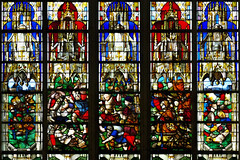
This window is a composite assembly combining fragments of sixteenth-century stained glass with nineteenth-century architectural structures and extensive twentieth-century restoration. The present arrangement consists of five tall lancets surmounted by a unified canopy system reconstructed in 1852, with bases and pedestals also installed at that time.
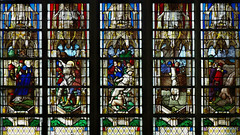
This window (c1550) illustrates episodes from the martyrdom of St Vincent of Saragossa, one of the most widely venerated deacons of the early Church. Created by a Rouen atelier in the early sixteenth century, the glass adopts the familiar layout of the Saint-Ouen narrative series: scenes arranged beneath richly architectural Gothic canopies, each panel presenting a distinct moment from the saint’s Passion.
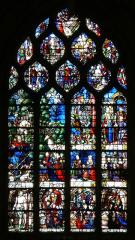
The stained-glass window illustrating the Legend of St Eustace (baie n° 18) in Saint-Étienne de Beauvais is a composite Renaissance work, produced in successive campaigns between 1553 and c. 1575. Its extended execution reflects a cumulative process of patronage, bringing together multiple donors, artists, and workshops within a single coherent narrative cycle.
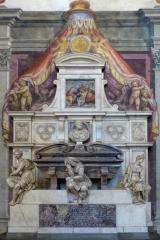
This tomb dedicated to Michelangelo was created by Vasari in 1570 and contains elements of Sculpture, Architecture and Painting.

The Lady Chapel at Bourges Cathedral has three stained glass windows from the late 16th century that tell the stories surrounding the Life of the Virgin Mary.

Created in 1619 this late Death and Assumption of the Virgin stained glass window is in Bourges Cathedral France.
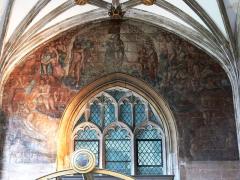
This "Doom" painting in St Mary's Warwick, is copy (1678), by Richard Bird, of Michelangelo's Last Judgment in the Sistine Chapel. The left hand side of the work has been restored but the right hand side left unrestored at present.
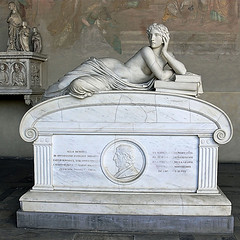
Allegorical figure of Science on the tomb of the physicist Ottaviano Fabrizio Mossott (d1863) in the Camposanto Monumentale, Pisa, by the sculptor Giovanni Duprè.
Pages
- « first
- ‹ previous
- 1
- 2
- 3
- 4