
Index of Renaissance all
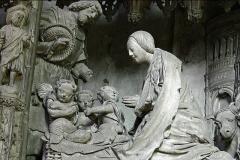
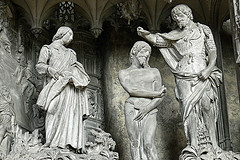 Above the choir screen at Chartres Cathedral are some 40 sculpted reliefs of biblical scenes, and other scenes from the life of the Virgin Mary. The scenes were sculpted by some of the best artists in France and were commissioned at different times over a 200 year period from 1510 to 1720.
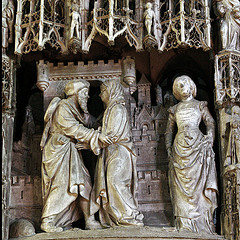
The first sequence of sculpture around the choir screen, starting at the western end of the south ambulatory, is the work of Jehan Soulas from 1519-1521. Sculpted from the hard limestone from the Tonnerre quarry, they consist of scenes from the Gospel of James, depicting the annunciation of the Virgin Mary to Joachim and St Anne, the birth of Mary, and the presentation of Mary in the temple.
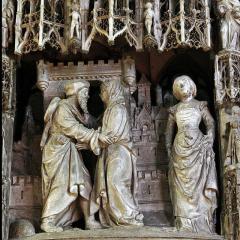
This second sequence of sculpture on the choir screen, starting at the western end of the south ambulatory, is the work of Jehan Soulas from 1520-1535. Sculpted from the hard limestone from the Tonnerre quarry they consist of scenes from the Gospel of James, depicting the marriage of the Virgin Mary to Joseph, the annunciation, and the visitation.
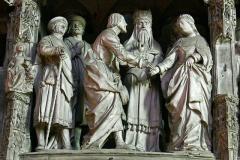

This third sequence of sculpture on the choir screen, starting at the western end of the south ambulatory, is the work of Jehan Soulas from 1521-1535. Sculpted from the hard limestone from the Tonnerre quarry, this consist of scenes depicting the Nativity, Circumcision, and Epiphany.
The Sacred Heart Chapel in Beauvais Cathedral contains this stained glass window by Engrand Le Prince. It was commissioned in 1522 by Louis de Roncherolles chamberlain and councillor to Francis I of France.

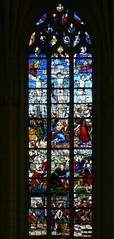
The Crucifixion window in the Church of Saint John the Baptist at Montrésor, in the Indre-et-Loire region of France, is one of the finest surviving examples of early sixteenth-century stained glass in the Loire Valley. Filling a tall Gothic lancet divided into several vertical lights, it unfolds as a vivid narrative of the Passion of Christ, rendered in rich Renaissance color and form.
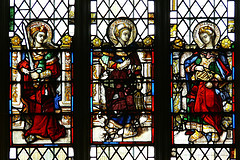
Three Sibyls east window: Persica, Europa, and Samia. St. Peter Coughton.
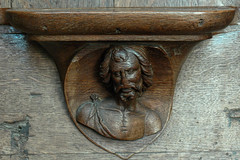 The choir stalls of the collegiate church of Saint-Jean-Baptiste at Montrésor form one of the most eloquent ensembles of Renaissance woodcarving in Touraine. They were made around 1530-1540, when Imbert de Batarnay, seigneur of Montrésor and counsellor to four French kings, endowed the new collegiate foundation he had created in 1521.
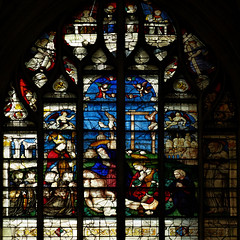
Renaissance-era stained glass window depicting the Pieta, created by the master glass painter Bertin Duval in 1530 and installed in the choir of Notre-Dame Church in Alençon
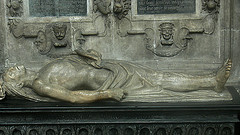 This monument to Louis de Brézé (d1531) is the work of Jean Goujon (1510-1572) who was commissioned by Diane de Poitiers, Louis wife. Louis was the son of King Charles VII of France's illegitimate daughter Charlotte de France.
This window in Saint-Étienne de Beauvais, is dated 1548 and i9s signed by Nicolas le Prince. It contains three scenes from the life of St Peter, and the conversion of St Paul on the Road to Damascus.
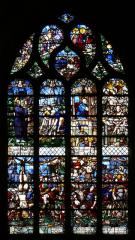

The church at Saint Romain sur Cher was rebult in the C16 and restored in the C19. The north and south walls of the apse are painted with scenes of the Decapitation of John the Baptist and the Baptism of Christ on the north wall, and on the south wall is the Resurrection. Both of these paintings were restored in 1859.
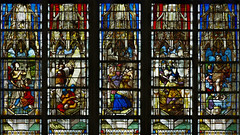
This window (c1550) presents a sequence from the Life and Martyrdom of St Agnes, the young Roman virgin celebrated for her steadfast refusal to accept a pagan suitor and her unwavering confession of faith. Produced by a Rouen workshop in the early sixteenth century, the window follows the typical Saint-Ouen format: narrative scenes set beneath tall Gothic canopies, framed by alternating architectural and landscape elements.
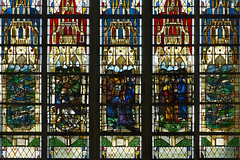
This window (c1550) is a composite assemblage combining fragments of sixteenth-century narrative glass with nineteenth-century architectural framing and extensive twentieth-century restoration. The programme appears to have depicted episodes from the life of an unidentified saint. According to Jean Lafond, one of the surviving scenes may represent the translation of relics, suggesting a cycle related either to Saint Ouen or Saint Leufroy. The identification, however, remains uncertain due to the fragmentary nature of the surviving iconography.
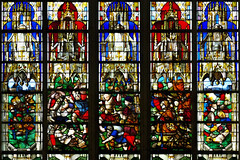
This window is a composite assembly combining fragments of sixteenth-century stained glass with nineteenth-century architectural structures and extensive twentieth-century restoration. The present arrangement consists of five tall lancets surmounted by a unified canopy system reconstructed in 1852, with bases and pedestals also installed at that time.
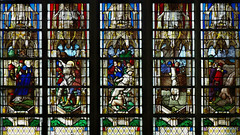
This window (c1550) illustrates episodes from the martyrdom of St Vincent of Saragossa, one of the most widely venerated deacons of the early Church. Created by a Rouen atelier in the early sixteenth century, the glass adopts the familiar layout of the Saint-Ouen narrative series: scenes arranged beneath richly architectural Gothic canopies, each panel presenting a distinct moment from the saint’s Passion.
The stained-glass window illustrating the Legend of St Eustace (baie n° 18) in Saint-Étienne de Beauvais is a composite Renaissance work, produced in successive campaigns between 1553 and c. 1575. Its extended execution reflects a cumulative process of patronage, bringing together multiple donors, artists, and workshops within a single coherent narrative cycle.
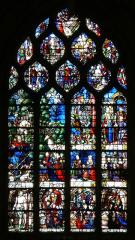

1540 stained glass in St Godard Rouen tell the story of Saint Romain (Romanus).

This tomb dedicated to Michelangelo was created by Vasari in 1570 and contains elements of Sculpture, Architecture and Painting.

The Lady Chapel at Bourges Cathedral has three stained glass windows from the late 16th century that tell the stories surrounding the Life of the Virgin Mary.