
Index of Renaissance all

In cell 7 of San Marco monastery a fresco, by Fra Angelico assisted by Benozzo Gozzoli, depicts a blindfolded Christ who is enthroned holding a cane and a globe.
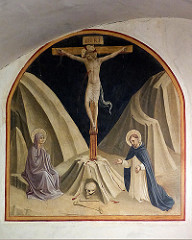
Crucifixion frescoes by Fra Angelico in the monk cells at San Marco monastery in Florence. These images are mainly in the cells for novices and were painted between 1438 and 1443 by Fra Angelico and his apprentices.
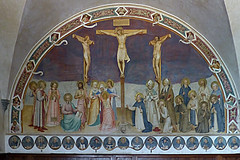
This crucifixtion fresco (1441-1442) is by Fra Angelico in the Chapter House of the San Marco monastery in Florence.

Cell 39 on the second floor of the San Marco convent was reserved for Cosimo de Medici. The fresco on the wall is the Adoration of the Magi by Benozzo Gozzoli.
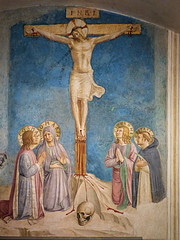
Crucifixion fresco (1441-2) by Fra Angelico in cell 38 on the second floor of the San Marco convent.
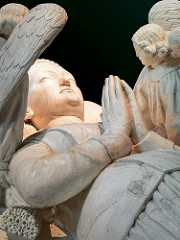
Agnès Sorel (d1450) was the mistress of King Charles VII of France to whom she gave birth to three daughters to Charles VII.
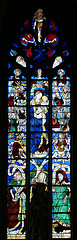
This stained glass window in the Lady Chapel of Evreux Cathedral was a given to the cathedral by King Louis XI of France between 1467 and 1469.
This four-light window depicts the Annunciation to the Virgin Mary, a masterwork of mid-15th-century French stained glass and one of the earliest panels in the south ambulatory cycle at Bourges Cathedral. At the centre, the Archangel Gabriel, richly vested in a scarlet cope patterned with gold shells and miniature saintly figures, kneels before the Virgin Mary, who stands at the right holding a book of hours and clothed in green and white robes edged with gold
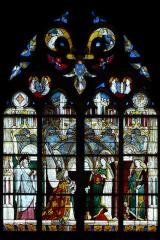
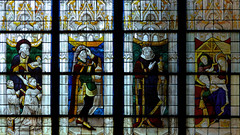
This window depicts the Adoration of the Magi, one of the most accomplished surviving examples of mid-15th-century glass painting in Bourges Cathedral. The composition unfolds across four lights beneath a framework of delicate Gothic canopies enriched with gilded tracery and pinnacles.
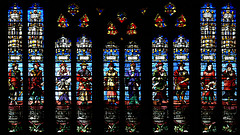 Some of the 16th century and earlier stained glass that can be found in Beauvais France. In particular the works of the le Prince family in Beauvais Cathedral and the parish church of St Ettiene.
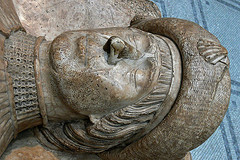
This funerary monument depicts Don García Osorio, a knight of the Order of Santiago, shown in repose with hands crossed upon his sword, a symbol of both chivalric honor and Christian faith. Carved in Toledo (1499-1505), probably by a sculptor influenced by Egas Cueman or Sebastián de Almonacid.
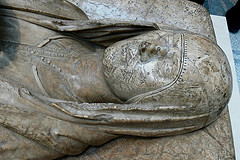
Effigy of Donna Maria de Perea wearing a simple dress and with rosary in her hands.
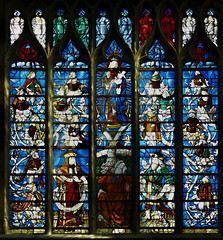
These pages document medieval stained glass in the churches of Rouen.

This Tree of Jesse in the church of St Godard Rouen, is the work of Arnoult de Nimégue (1506).
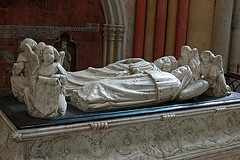
The Tomb of the Children of France is a traditionally attributed to Michel Colombe (c. 1430–1515), one of the foremost French sculptors of the late Gothic and early Renaissance periods, and is widely regarded as one of Michel Colombe’s most touching and refined works.
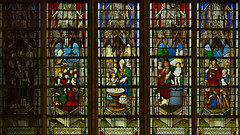
This window forms part of the late-medieval glazing cycle devoted to St Austremoine (St Austremonius), traditionally regarded as one of the missionary bishops sent from Rome to evangelise Gaul. The panels adopt the rich narrative style characteristic of Rouen workshops in the early sixteenth century, combining brightly modelled figures, deep architectural canopies, and landscape backdrops that open the narratives into broad, coherent sequences.
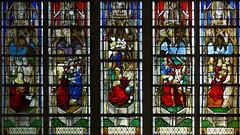 The south aisle of the nave at Saint-Ouen preserves one of the most varied yet coherent hagiographic ensembles in the church’s glazing programme. Although the windows today comprise mixtures of sixteenth-century fragments, nineteenth-century architectural refitting, and extensive twentieth-century restoration, they collectively articulate a single, sustained theme: the commemoration of exemplary saints whose lives, virtues, and martyrdoms offered models for Christian devotion.
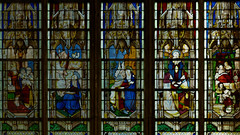
This window narrates episodes from the apocryphal infancy cycle concerning St Anne and St Joachim, parents of the Virgin Mary. Executed in the early sixteenth century by a Rouen workshop, the glass combines dense architectural canopies with clear, compartmentalised scenes, allowing the viewer to follow the story across multiple lights.
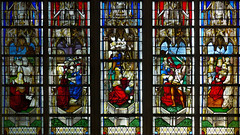
This window (c1508) depicts key moments from the life and martyrdom of St Catherine of Alexandria, a learned noblewoman whose legend was widely celebrated in late-medieval Europe. The glazing, produced by a Rouen workshop in the early sixteenth century, follows the characteristic format of the Saint-Ouen cycles: tightly framed narrative scenes beneath elaborate Gothic canopies, enriched with vivid colour and detailed architectural settings.
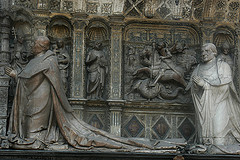 Started in 1515, and completed in 1525, this tomb is the work of the Roullant Le Roux, Rouen cathedral's master mason of the time. It is a memorial to the French cardinal and archbishop of Rouen George d'Amboise (d1510), the other figure is his nephew George d'Amboise (d1550) who became archbishop of Rouen on his uncle's death.