Annunciation to the Shepherds - Worcester Cathedral
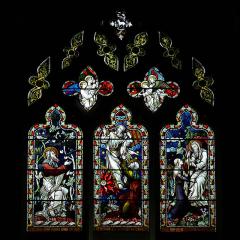
Situated in the south aisle this stained glass window (1877) by John Hardman depicts the Annunciation to the Shepherds.
Situated in the south aisle this stained glass window (1877) by John Hardman depicts the Annunciation to the Shepherds.
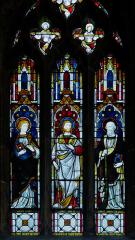
This three-light stained glass window, dated 1869 and made by Burlison & Grylls ⓘ, depicts St John ⓘ, St Philip ⓘ, and St James the Less ⓘ, presented as standing apostles beneath an angelic tracery bearing texts from the Apostles’ Creed. The window forms part of the coherent Victorian apostolic programme at Kings Sutton, combining doctrinal clarity with restrained Gothic revival design.
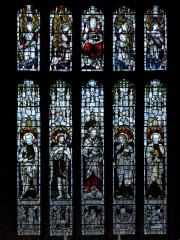
This four-light window presents a clear, didactic pairing of New Testament witnesses above Old Testament prophets, a scheme that emphasises continuity between prophecy and fulfilment.
Upper register: The Evangelists, each standing beneath canopies, are shown from left to right as Matthew, Mark, Luke, and John, identifiable by their attributes and inscriptions. Their placement in the upper tier underscores their authority as authors of the Gospel narrative.
This five-light stained-glass window, installed in 1889 in the church at Litchborough, was made by J. Powell & Sons (Whitefriars), to a design by Christopher Whall. The window presents a sequence of apostolic and Christological figures above a narrative predella, combining symbolism, scripture, and pastoral theology.
The upper register consists of five standing figures beneath architectural canopies:
The left-hand light shows St Peter ⓘ, holding the keys and a book, signifying his authority and role as the foundation of the Church.
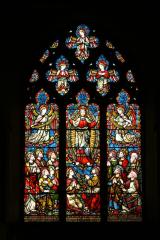
This three-light east window., in All Saints, Braunston, depicts the Ascension of Christ in a clear, vertically organised composition typical of Victorian ecclesiastical stained glass. In the central light, Christ rises heavenwards within a mandorla, his right hand raised in blessing, while the apostles below gather in a semicircle, their varied gestures conveying wonder, devotion, and astonishment at the moment of departure.
Alexander Benjamin Baillie (1787-1864), a Scot who moved south to London and was involved in stained glass production before 1815.
William Behnes (1794–1864) was an English sculptor active in the first half of the nineteenth century, known for funerary monuments, portrait busts, and commemorative sculpture. Trained within the academic tradition of late Georgian neoclassicism, he developed a practice that combined formal discipline with a pronounced sensitivity to psychological expression.
Located in the south choir aisle of Salisbury Cathedral, this monument commemorates Bishop George Moberly, who served as Bishop of Salisbury from 1869 until his death in 1885.
Monument to Bishop Joseph Allen (1845).
Bishop Woodford (d1885) Monument. Ely Cathedral.