
Ascension Window, Braunston, Northamptonshire
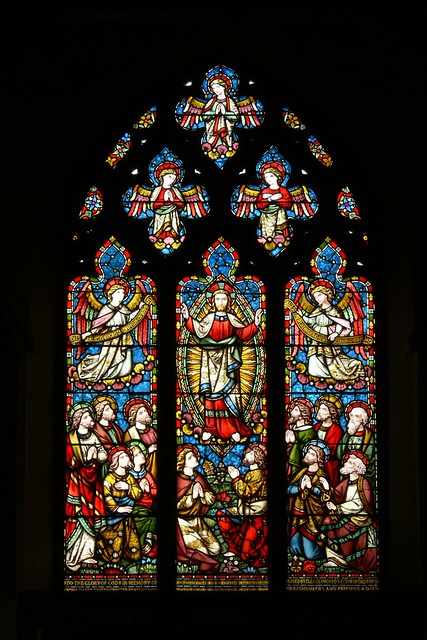
This three-light east window., in All Saints, Braunston, depicts the Ascension of Christ in a clear, vertically organised composition typical of Victorian ecclesiastical stained glass. In the central light, Christ rises heavenwards within a mandorla, his right hand raised in blessing, while the apostles below gather in a semicircle, their varied gestures conveying wonder, devotion, and astonishment at the moment of departure.
The flanking lights are occupied by angels, who turn inward toward the central event, visually reinforcing the upward movement of the scene and guiding the eye toward the Ascension itself. Above, smaller angelic figures fill the tracery, completing the celestial register and framing the ascent within a heavenly hierarchy.
The window is characterised by strong narrative clarity, saturated colouring, and careful balancing of figures across the three lights. Drapery is handled with restraint, and facial expressions are legible at distance, reflecting the practical and didactic aims of late-19th-century parish glazing. The use of the mandorla to enclose Christ emphasises the theological separation between the earthly and the divine, while the apostles’ grouping anchors the scene firmly in the human realm.
Executed in 1872 by Alexander Gibbs ⓘ,1 the window exemplifies the firm’s approach to biblical subjects: orthodox in iconography, orderly in composition, and designed to communicate clearly within the architectural setting of the church.