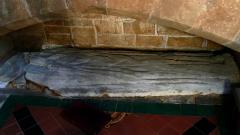
Effigy of priest - Old Arley, Warwickshire
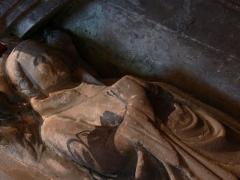
Mid C14 recumbent effigy of a priest in tomb recess.
Mid C14 recumbent effigy of a priest in tomb recess.
This mid-fifteenth-century effigy depicts a priest shown vested for the celebration of Mass, carved in low relief and set beneath an architectural recess.
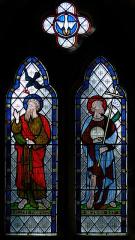
This two-light stained-glass window, dating from the late 1860s, was made by Clayton & Bell ⓘ for the church at Tiffield. It pairs figures of the Old and New Testaments: Elijah the Prophet and St John the Baptist ⓘ, linked typologically through their prophetic witness and ascetic character.
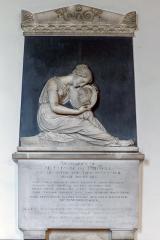
This wall monument, dated 1831, commemorates Elizabeth Darnell and is located at Thrapston, Northamptonshire. It was commissioned by her daughter, Mary Montague, and is signed by the sculptor Edward Physick ⓘ (1810–1842), whose short career produced a small but refined body of funerary work.
Alabaster memorial to Elizabeth Knightley (d1602). A recumbent effigy with somewhat brightly coloured decoration. All Saints, Norton, Northamptonshire.
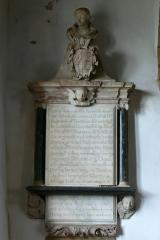
An inscribed wall monument of white marble with black Ionic half-columns, surmounted by a sculpted bust and heraldic cartouche, commemorating Elizabeth Orme, who died on 20 January 1692. The monument combines classical architectural framing with emotive figurative carving, including a cherub’s head beneath the cornice, and belongs firmly to the late 17th-century English commemorative tradition.
Memorial to Elizabeth Verney (d1633).
This monument is to Elizabeth Williams (d1622) who died in childbirth, an effigy of a baby in its chrisom shroud lies by her side. Her sister also died in childbirth a year later and a monument to her is nearby. Both monuments are probably the work of Samuel Baldwin of Stroud ⓘ.
The Emmaus window by Heaton, Butler & Bayne, created in 1925, is a stained-glass triptych set in a South chancel window at Market Bosworth. Made by the London firm known for its Victorian and Pre-Raphaelite style, it depicts the biblical Supper at Emmaus across three panels.
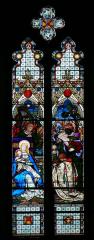
"Adoration of the Magi" by Heaton, Butler & Bayne (1869).