England
Great Malvern Priory is a former Benedictine priory church whose architecture, stained glass, and monuments preserve a long and complex record of religious life from the Norman period to the present. Founded in the later eleventh century as a dependent cell of Worcester Cathedral Priory, the site occupies a position of early importance within the Norman monastic expansion in western England.
A substantial body of medieval stained glass survives at Great Malvern Priory, although its condition and completeness vary considerably from window to window. Several major fifteenth-century windows remain largely intact, most notably the Magnificat Window, the Founder’s Window, and the glazing of the Lady Chapel. Elsewhere, survival is more fragmentary: the great east window, though once a dominant feature of the church, now survives largely in dispersed panels and fragments rather than as a complete scheme.
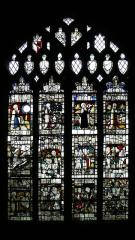
This fifteenth century stained glass panel depicts William the Conqueror, in 1085, giving a charter to the monk Aldwin. It can be found in the north wall clerestory window of the chancel in Great Malvern Priory.
This remarkable window (1490-1505), rediscovered packed away in 1932, forms the lower section of the great east window at Stanford-on-Avon. It is one of the most striking survivals of late medieval royal propaganda in stained glass, created to celebrate the accession and legitimacy of Henry VII and the founding of the Tudor dynasty.
Set within the tracery lights of the great east window at St Peter’s, Coughton, these panels form part of a distinguished group of Tudor heraldic glass. At the centre are the royal arms of Henry VIII, impaled with those of Catherine of Aragon, enclosed by the initials H and K and surrounded by the Tudor emblems of the rose, portcullis, and crown. The inclusion of Catherine’s arms confirms that the glass was installed before the annulment of their marriage in 1533, most likely during the first decade of Henry’s reign.