Henry Denton Brass - Higham Ferrers, Northamptonshire
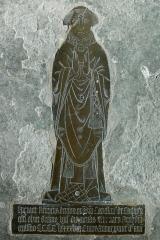
Henry Denton (1498) chaplain of Chelveston, a small village near to Higham Ferrers.
Henry Denton (1498) chaplain of Chelveston, a small village near to Higham Ferrers.
This remarkable window (1490-1505), rediscovered packed away in 1932, forms the lower section of the great east window at Stanford-on-Avon. It is one of the most striking survivals of late medieval royal propaganda in stained glass, created to celebrate the accession and legitimacy of Henry VII and the founding of the Tudor dynasty.
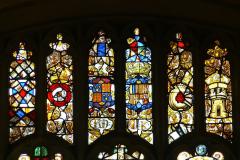
Set within the tracery lights of the great east window at St Peter’s ⓘ, Coughton, these panels form part of a distinguished group of Tudor heraldic glass. At the centre are the royal arms of Henry VIII, impaled with those of Catherine of Aragon, enclosed by the initials H and K and surrounded by the Tudor emblems of the rose, portcullis, and crown. The inclusion of Catherine’s arms confirms that the glass was installed before the annulment of their marriage in 1533, most likely during the first decade of Henry’s reign.
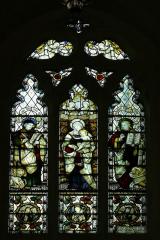
Two Kempe and Tower windows from 1914. The first shows St Luke ⓘ, Virgin and Child, and St John the Evangelist ⓘ. The upper lights of the second window shows the Epiphany whilst the bottom light depict the Presentation in the Temple.
This tracery window depicts the Holy Spirit in the form of a descending dove, set against a radiant field of blue glass and stylised rays of light. A scroll bearing the inscription “Peace in heaven & Glory in the highest” reinforces the window’s theological focus on divine presence, reconciliation, and praise.
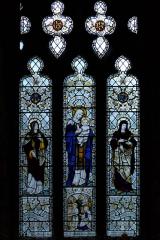
This three-light stained glass window of 1926, signed by J. Powell & Sons (Whitefriars), presents a symbolic devotional programme centred on Christian virtue rather than named saints.

Stained glass panel (1338-1340) depicting Hugh Despenser the Younger who was married to Eleanor the sister of Gilbert de Clare. Hugh Despenser became the favourite of Edward II but was especially disliked by Queen Isabella, and executed when Edward II was deposed in 1326.
After the execution of Hugh Despenser his remains were gathered together and buried here in Tewkesbury. The tomb once contained over 40 statues, all of which have now gone. The current tomb in the alcove is that of Abbot John Cotes (d1337) which was moved into this location in the 17th century.
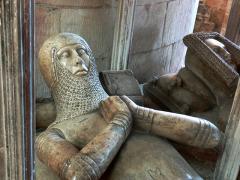
This tomb of Hugh and Elizabeth, in the chancel of Tewkesbury Abbey, is of alabaster and the effigies are portraits of them both. The canopy once contained 26 statutes and was considered one of the finest in England.

The western most window in the St Anne Chapel, Malvern Priory, has twelve scenes depicting the Story of Isaac ⓘ, Joseph, and Moses. It is dated to between 1440-1450 and was probably the gift of Isabel Despenser and Richard de Beauchamp, 13th earl of Warwick.