Bishop James Johnson - Worcester Cathedral
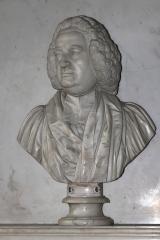
This bust of Bishop of Worcester James Johnson (d1774), is by Joseph Nollekens ⓘ.
This bust of Bishop of Worcester James Johnson (d1774), is by Joseph Nollekens ⓘ.
Bust of Bishop John Gaugen (d1662), Worcester Cathedral. John Gaugen was made Bishop of Worcester in May 1662 but died in September 1662 of "stone and strangury" - a complication of kidney stones.
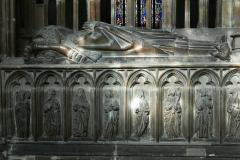
This carved alabaster monument of Bishop John Stanbury contains his effigy and has saints and angels as mourners carrying shields around all sides. Unfortunately the heads of the angels were chipped off during the reformation.
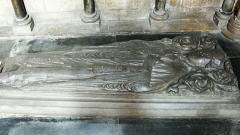
Semi reclining effigy of Bishop Peter Gunning (d1684).
This tomb in the South choir contains the effigy of Bishop Richard Mayew (d1516) under an elaborate canopy, and with weepers ⓘ around the base. The weepers are thought to represent saints and were damaged during the reformation.
Purbeck marble ⓘ effigy of Bishop Thomas de Cobham (d1327). Worcester Cathedral.
This mid 13th century tomb of Bishop Walter de Cantelupe (d1266) is made of Purbeck marble ⓘ. The relief of the effigy is more rounded than that of the nearby tomb of his predecessor the bishop of Worcester William de Blois (d1236) which is still in the Romanesque style and shows the development to the more rounded forms of the early Gothic.
This much mutilated, Purbeck marble ⓘ, effigy is of Bishop Walter de la Wyle ⓘ at Salisbury Cathedral.
Bishop of Worcester 1218-1236. The effigy on the tomb is in the Romanesque style and lacks the detailed modelling that would become the hallmark of Gothic sculpture.
William de la Corner (d1291) was bishop of Salsibury from 1289 until his death whilst on his second mission abroad as an ambassador for Edward I. This tomb is just 1.1 metres in length and is sometimes described as the tomb of a boy bishop. However, small tombs like this were often built when just the heart of the deceased was buried, in this case it was the bones that were returned to Salisbury.