Alexander de Holderness - Peterborough Cathedral.
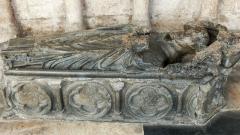
This effigy on a low tomb chest is thought to be Alexander of Holderness (d1226) abbot of Peterborough.
This effigy on a low tomb chest is thought to be Alexander of Holderness (d1226) abbot of Peterborough.
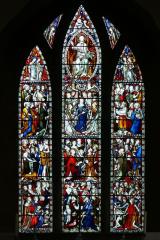
The east window at All Saints, Ladbroke is one of the most densely populated compositions produced by Hardman & Co., containing over eighty individual figures arranged across the lights and tracery. It represents the firm at the height of its High Victorian confidence, where scale, narrative ambition, and visual abundance are combined within a tightly controlled Gothic framework.
Tomb of Sir Thomas Andrews (d1564) and his two wives, Katherine and Mary.
The timber roofs of the nave, chancel, and south-east chapel at All Saints date from the major late fifteenth-century rebuilding of the church, undertaken from c. 1470 onwards under the patronage of the wealthy wool merchants John and William Browne. This campaign transformed the clerestory ⓘ, aisles, tower, and spire, and included the construction of richly carved angel roofs.
Examples of the friezes and fragments of stone carvings from the 8th century Anglo Saxon monastery at Breedon-on-the-Hill.

Set in the tracery above the three-light window depicting St Anne, the Virgin Mary ⓘ, and St Elizabeth—designed respectively by Ford Madox Brown (Anne and Elizabeth) and Edward Burne-Jones ⓘ (central Mary)—this Annunciation scene was designed by William Morris in 1880.
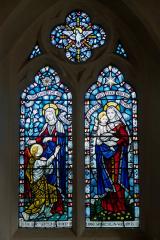
This two-light stained-glass window of 1959, signed by J. Hardman Studios, is located in the church at Abthorpe. The window presents paired Marian subjects: the Annunciation and the Virgin and Child, unified by scriptural inscription and symbolic tracery.
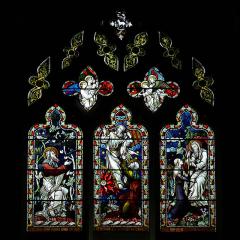
Situated in the south aisle this stained glass window (1877) by John Hardman depicts the Annunciation to the Shepherds.
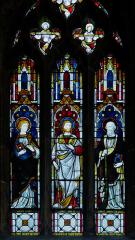
This three-light stained glass window, dated 1869 and made by Burlison & Grylls ⓘ, depicts St John ⓘ, St Philip ⓘ, and St James the Less ⓘ, presented as standing apostles beneath an angelic tracery bearing texts from the Apostles’ Creed. The window forms part of the coherent Victorian apostolic programme at Kings Sutton, combining doctrinal clarity with restrained Gothic revival design.
This four-light window presents a clear, didactic pairing of New Testament witnesses above Old Testament prophets, a scheme that emphasises continuity between prophecy and fulfilment.
Upper register: The Evangelists, each standing beneath canopies, are shown from left to right as Matthew, Mark, Luke, and John, identifiable by their attributes and inscriptions. Their placement in the upper tier underscores their authority as authors of the Gospel narrative.