PeriodIndex

Royal Portal - Chartres Cathedral

Royal Portal - Chartres Cathedral

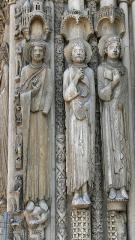
Since its construction in around 1150, the western portal of Chartres Cathedral, decorated with elongated late Romanesque style figures of the Kings and Queens of the Old Testament has been known as the Royal Portal.


Gothic Sculpture

The Gothic period is characterized by the early simplicity of naturalistic figures to the late excessively enriched elegance and elaborate clothing of the figures in the later period, the subject matter of Gothic sculpture featured the mysticism of the mid to late medieval age with an emphasis on suffering and emotion.


Chartres Cathedral

Chartres Cathedral

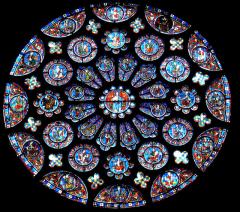
Chartres Cathedral has some of the most beautiful medieval stained glass windows to have survive the upheavals of the last 800 years. The earliest date from the mid 12th century, but most are from the 13th century.


The Apostles in Art

The Apostles in Art: Witness, Memory, and Transformation


Lintel South Portal Bourges Cathedral

Pope Alexander III

Following the death of Pope Adrian IV , Rolando of Siena was elected pope as Alexander III on 7 September 1159. His election immediately plunged the Church into schism: on the same day, Cardinal Ottaviano de' Monticelli was proclaimed antipope Victor IV. Each excommunicated the other, but Victor’s authority was confined largely to territories controlled by the Holy Roman Emperor Frederick I , whose support transformed the schism into a prolonged contest between papal independence and imperial power.

Crucifixion - Saint Albans Cathedral

Crucifixion - Saint Albans Cathedral

This late twelfth-century mural of the Crucifixion survives on the south-west nave pier of St Albans Cathedral. Executed in a restrained Romanesque manner, the composition presents Christ crucified between the Virgin Mary and St John the Evangelist .

Our Lady of Orcival - Puy-de-Dôme

Our Lady of Orcival - Puy-de-Dôme

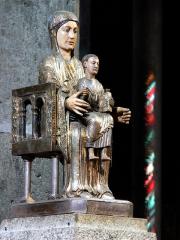
In form and iconography, the statue is closely modelled on the celebrated “Golden Virgin” commissioned by the Bishop of Clermont in 946, a cult image that was destroyed during the Revolution when it was melted down for coinage. On stylistic and material grounds, the Orcival Virgin is now dated to c. 1170, making it a later but faithful reinterpretation of the earlier episcopal image.


Reliquary Shrine of the Bishops of Cambrai–Arras

Reliquary Shrine of the Bishops of Cambrai–Arras

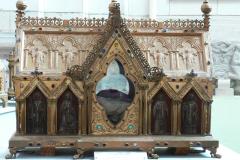
This shrine, shaped like a miniature Gothic church, was originally conceived to house the relics of Saint Vindicianus , an early bishop of Cambrai–Arras and a key figure in the Christian history of Artois. Its architectural form, precious materials, and central rock-crystal window, allowing the relics to be seen, proclaim its function as a prestige reliquary and focal point of local devotion.

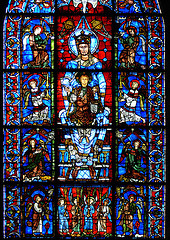
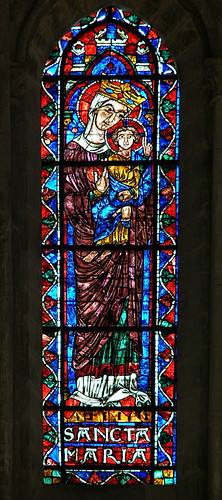
Blue Virgin


Set into a 13th century window, in the south ambulatory of the choir (bay 44) of Chartres Cathedral, this is one of the most celebrated medieval artworks in the Cathédrale Notre-Dame de Chartres.It dates primarily to c. 1180 CE, with later additions around 1225 CE, making it a rare survivor from the pre-1194 fire that destroyed the earlier Romanesque cathedral.


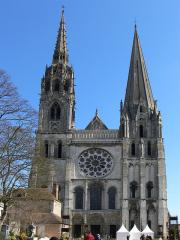
Notre-Dame de Chartres

Notre-Dame de Chartres

Designated a World heritage Site by UNESCO in 1979 the Cathedral of Notre-Dame de Chartres was built from between 1145 and 1250. It's high nave is spanned by ogival pointed arches to form the vault, and the walls are supported by double flying buttresses. Chartres is the first building to have used buttresses as a structural element.


Chartres Cathedral is also unique in having retained almost all of its original 12th and 13th century stained glass.

Confessors - Chartres Cathedral


In addition to the martyrs, the south porch contains a sequence of images of those that had proclaimed Christian beliefs during periods of suppression (confessors).

Martyrs - Chartres Cathedral


The south porch of Chartres Cathedral contains a series of sculptures, that were made between 1194 and 1230, on the subject of the martyrdom of saints.


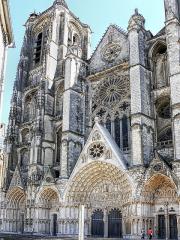
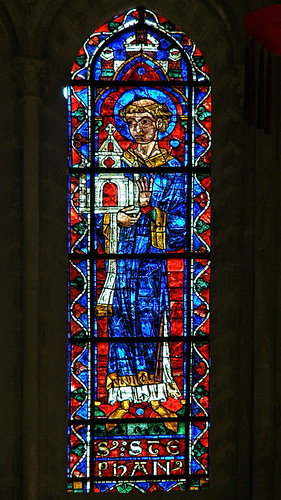
Saint-Étienne Bourges

Saint-Étienne Bourges

Construction of Bourges cathedral began in 1195 and was finally completed and dedicated to St Stephen in 1324. With its five portals the western façade, which was completed in 1230, is the widest of any Gothic church spanning some 40 metres.

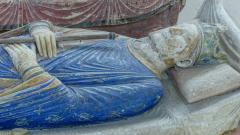
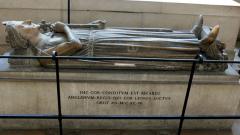
Richard Coeur-de-Lion - Rouen Cathedral, France

Richard Coeur-de-Lion - Rouen Cathedral, France

Tomb of Richard I of England (d1199). This is one of three tombs to Richard I, this one is said to contain his heart, his entrails were buried in Châlus (where he died), and the rest of his body was buried at the feet of his father, Henry II, at Fontevraud Abbey in Anjou.


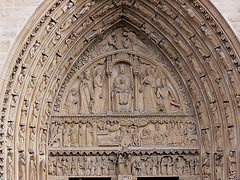
Portal Of St. Anne

The portal of St Anne on the right of the western façade was built in 1200 and is the earliest of the three portals to be built. The tympanum is actually dated to about 1150 and was once part of the earlier cathedral of St. Stephen whose western façade was once 40 metres to the west of the present Cathedral.


New Testament Figures - Bourges Cathedral, Choir Clerestory (South Side, c.1200–1225)

The south side of the choir clerestory at Bourges Cathedral contains a remarkably complete early-Gothic cycle of New Testament figures, created between about 1200 and 1225. These tall, independent lancets depict apostles and evangelists in a unified iconographic programme, forming a deliberate counterpart to the Old Testament prophets on the north side of the choir.

The only New Testament figures not on the south side are those in the apex window, w.200 - the Virgin and Child with St Stephen — which stand on the north side and serve a special liturgical and dedicatory function.

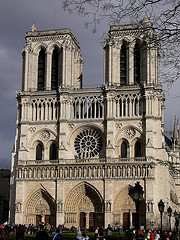
Western facade - Notre-Dame Cathedral, Paris


The western façade of the cathedral of Notre-Dame in Paris, with its twin towers, was built between 1200 and 1240. With its three portals containing scenes from the life of the Virgin Mary , the Last Judgment, and scenes from the life of St. Anne, it is considered one of the finest examples of early Gothic architecture.


Pages