
Our Lady of Orcival - Puy-de-Dôme
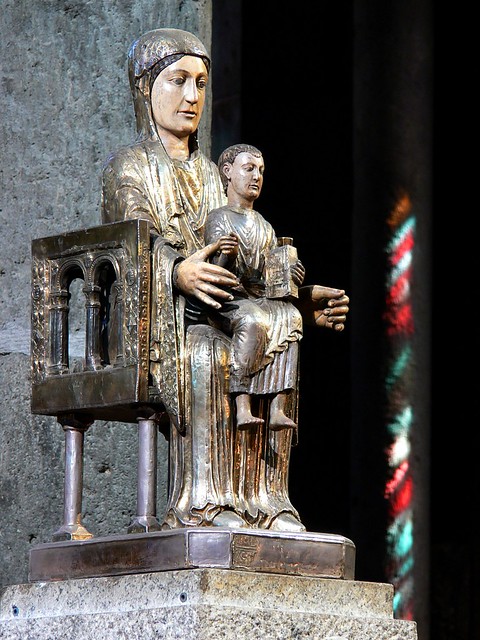
In form and iconography, the statue is closely modelled on the celebrated “Golden Virgin” commissioned by the Bishop of Clermont in 946, a cult image that was destroyed during the Revolution when it was melted down for coinage. On stylistic and material grounds, the Orcival Virgin is now dated to c. 1170, making it a later but faithful reinterpretation of the earlier episcopal image.
Restoration undertaken in 1959 revealed the statue’s complex construction: a core of walnut wood, carved and then enriched with gilded silver and enamel. The Virgin is enthroned, seated frontally in the traditional Romanesque manner, with the throne articulated by arched forms that symbolically evoke the architecture of the church itself. The hieratic pose, frontal symmetry, and emphasis on surface treatment place the work firmly within the Romanesque sculptural tradition.
From the Middle Ages to the present day, the statue has remained a focus of popular devotion. It continues to play a central role in local religious life and is carried in procession through the streets of Orcival each year on Ascension Thursday, maintaining a continuity of cult practice that underscores its enduring spiritual and cultural significance.1
- 1. Ministry of Culture http://www.culture.gouv.fr/culture/inventai/itiinv/orcival/uk/orci12.htm
