
William Bagot Brass - Baginton, Warwickshire.
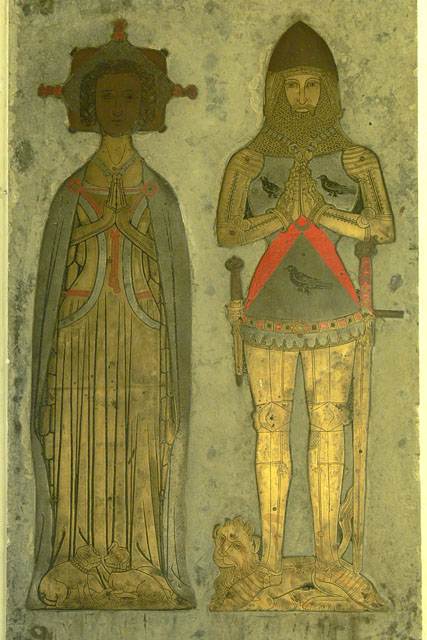
This large monumental brass commemorates William Bagot (d. 1407) and his wife Margaret, and belongs to the stylistic group conventionally designated London “C”. The figures are engraved at near life-size (4ft 9.5 inches high) and display the assured linear handling, controlled proportions, and compositional clarity characteristic of this London workshop at the turn of the fourteenth and fifteenth centuries.


William Bagot is shown in late Plantagenet armour, wearing a pointed bascinet with camail, and a jupon secured by a broad bawdric across the hips. This combination places the brass within the earlier group of armed figures in which the jupon remains dominant, rather than being replaced by the cyclas or surcoat. Margaret Bagot stands beside him, rendered with equal scale and dignity, reinforcing the commemorative balance of the composition.
Style and typology
In typological terms, the Baginton brass belongs to a group of late fourteenth- and early fifteenth-century monuments characterised by the continued use of the jupon over armour. Comparable examples include the brasses of William de Aldeburgh at Aldborough (c. 1360), a knight of the Dallingridge family at Fletching (1395), Sir George Felbrigge at Playford (1400), and Sir John Wingfield at Letheringham (c. 1400). The Bagot brass represents one of the latest survivals of this stylistic tradition.
The jupon worn by William Bagot is of particular interest, being charged with heraldry rather than finished with a plain or scalloped edge. It displays a chevron between three martlets, with a crescent for difference, placing the monument among a small and significant group in which the jupon functions as a heraldic surface. This treatment is closely comparable to the heraldically charged jupon of Sir George Felbrigge at Playford and reflects a conscious emphasis on lineage and identity.
The Collar of Esses
Both William and Margaret Bagot are shown wearing the Collar of Esses (SS).1 By the early fifteenth century, this collar had become the most prestigious knightly decoration after the Garter2and was widely recognised as a badge of allegiance to the House of Lancaster.
Its prominent display on both figures transforms the brass into a political as well as commemorative statement. Like many contemporary monuments, the Baginton brass uses the Collar of SS to signal loyalty, legitimacy, and alignment within the newly established Lancastrian regime.
Workshop context: London “C”
The engraving style places the brass securely within the output of the London “C” workshop, a stylistically coherent but quantitatively minor strand of London brass production. As noted by Nigel Saul, at the turn of the fourteenth and fifteenth centuries this workshop appears to have attracted significant patronage from individuals connected with the chamber staff of Richard II, situating its activity within a court-adjacent milieu.
The Bagot commission aligns closely with this pattern of patronage and supports the identification of London “C” as a workshop serving a politically and socially specific clientele.
Historical context
William Bagot’s political career provides essential context for the iconography of the brass. A close associate of Richard II and one of his continual councillors, Bagot was deeply implicated in the crisis that culminated in the king’s deposition in 1399. Following the accession of Henry IV, Bagot’s lands were initially confiscated, though he later secured restoration and a royal pension.
This process of political rehabilitation is reflected in the monument itself. The emphatic display of the Lancastrian Collar of SS, worn by both husband and wife, functions as a public declaration of renewed allegiance and restored status. The brass thus stands as a material witness to the personal and political realignments that followed the fall of Richard II.
For the wider political background, see:
King Richard II of England is deposed — 29 September 1399
Significance
The Baginton brass is a key document of late Ricardian and early Lancastrian England, combining conservative armour typology with highly charged political symbolism. Through its heraldic jupon, its use of the Collar of SS, and its association with the London “C” workshop, the monument illustrates how engraved brasses functioned not only as memorials, but as instruments of loyalty, rehabilitation, and historical memory in the years surrounding 1399.
- 1. Medieval Material Culture
- 2.
The Brasses Of England New York EP Dutton and Company 1907.p148.
- 3. a. b.
Divided Houses: The Hundred Years War Iii London Faber and Faber 2009.pp847-8.
- 4. ibid p858
- 5. ibid p860
- 6.
The Fourteenth Century 1307-1399 Oxford History Of England Oxford History Of England Oxford Clarendon Press 1959.p492.
- 7.
Divided Houses: The Hundred Years War Iii London Faber and Faber 2009.p862.