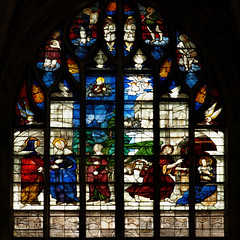
'The Annunciation and Visitation' is a stunning Gothic-style stained glass window created by the master glass painter Bertin Duval in 1531. It is located in the Notre-Dame Basilica (Basilique Notre-Dame) in Alençon, Normandy, France

'The Annunciation and Visitation' is a stunning Gothic-style stained glass window created by the master glass painter Bertin Duval in 1531. It is located in the Notre-Dame Basilica (Basilique Notre-Dame) in Alençon, Normandy, France
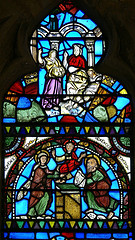
"Presentation in the Temple" panel originally from Saint-Denis near Paris (c1145).
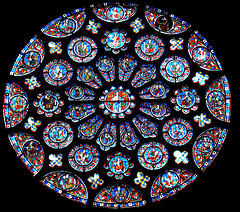
Chartres Cathedral has some of the most beautiful medieval stained glass windows to have survive the upheavals of the last 800 years. The earliest date from the mid 12th century, but most are from the 13th century.
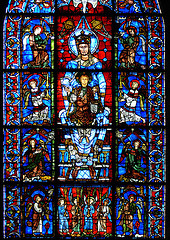
Set into a 13th century window, in the south ambulatory of the choir (bay 44) of Chartres Cathedral, this is one of the most celebrated medieval artworks in the Cathédrale Notre-Dame de Chartres.It dates primarily to c. 1180 CE, with later additions around 1225 CE, making it a rare survivor from the pre-1194 fire that destroyed the earlier Romanesque cathedral.
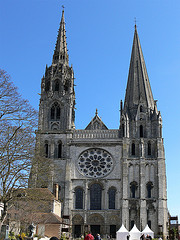 Designated a World heritage Site by UNESCO in 1979 the Cathedral of Notre-Dame de Chartres was built from between 1145 and 1250. It's high nave is spanned by ogival pointed arches to form the vault, and the walls are supported by double flying buttresses. Chartres is the first building to have used buttresses as a structural element.
Chartres Cathedral is also unique in having retained almost all of its original 12th and 13th century stained glass.
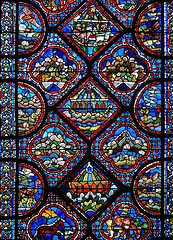
This early 13th century window depicts the story of Noah, was donated to the Cathedral of Chartres by the town's carpenters, wheelwrights, and coopers.
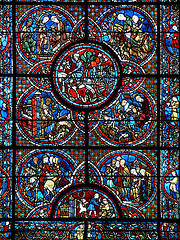
Saint Lubin, or Leobinus, was a 6th century bishop of Chartres. This window from the early 13th century depicts events in his life, and was donated to the cathedral by the Winesellers and innkeepers of the town of Chartres.
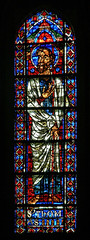
Window w.206 forms part of the major early 13th-century glazing programme of the choir clerestory at Bourges Cathedral. Like the other apostolic lancets in this zone, it presents three full-length apostles standing beneath architectural canopies, each framed by the characteristic red–blue geometric borders of the Bourges workshop. The style, palette, and facial types align closely with the glazing campaigns dated to c.1210–1215.
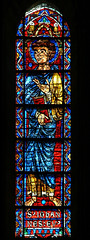 Window 204 consists of two tall lancets forming part of the celebrated early thirteenth-century clerestory glazing of Bourges Cathedral. The saints represented, Andrew on the left and John the Evangelist on the right, are shown as full-height standing figures beneath architectural canopies, framed by the characteristic geometric borders of the Bourges workshop.
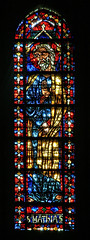
Window w.212, located high in the south choir clerestory of Bourges Cathedral, dates from c.1210–1215 and belongs to the earliest glazing phase of the High Gothic choir. The window presents two Evangelists, Mark and Luke, and one Apostle, Matthias.
This trio forms part of a wider apostolic–evangelist cycle distributed around the clerestory, each figure shown as a monumental standing saint set within a richly patterned Gothic frame.